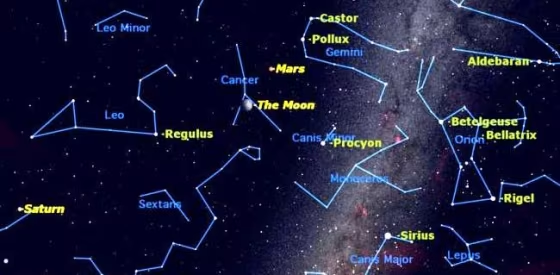
On Thursday night, many people may look up at the sky and ask, "What's that bright star next to the moon?"
The answer for Thursday night is Mars, but that answer changes night by night as the moon travels along the ecliptic, the path that the sun, moon and planets follow across the sky. If you ask the question again on March 29, the answer will be the ringed planet Saturn.
Such conjunctions of the moon and planets are regular reminders of how rapidly the moon moves across the sky.
Mars was in opposition to the sun on Jan. 29, when it appeared 14 arcseconds in diameter, one-120th of the diameter of the moon. Two months later, it is much farther away, and has shrunk to only 10 arcseconds in diameter.
This will be your last chance to get a good look at Mars until it approaches the Earth again in 2012.
The sky on these spring evenings presents a striking contrast between its western half, filled with the bright stars and constellations of winter, and its eastern half, with Regulus the only bright star. Mars sits in solitary splendor in Cancer, one of the most insignificant zodiac constellations, just above the plane of the Milky Way.







 FOR SUBSCRIBERSA harrowing ordeal aboard an Israel-bound plane







FOR SUBSCRIBERSThe debate over AI’s future rages on both coasts

But there is much lurking beyond the dim stars of spring, for we are entering the realm of the galaxies. The constellation Leo alone contains five of the brightest galaxies in Charles Messier's famous 18th-century catalog of deep sky objects.
FOR SUBSCRIBERSA harrowing ordeal aboard an Israel-bound plane
FOR SUBSCRIBERSThe debate over AI’s future rages on both coasts
When we look toward Leo, we are looking above the plane of our Milky Way galaxy at the depths of intergalactic space, unhindered by the clouds of dust and gas which fill our galaxy.
This article was provided to Space.com by , the leader in space science curriculum solutions.