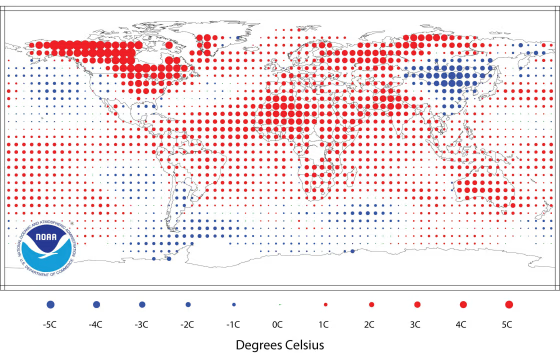
The planet's average land and sea temperature for April was 58.1 degrees Fahrenheit (14.5 Celsius), the hottest for any April since recordkeeping began in 1880, the National Oceanic and Atmospheric Administration said Monday.
That was 1.37 degrees F (0.76 C) above the 20th Century average of 56.7 degrees F (13.7 C).
Indeed, the world's average temperature was the highest on record for the January-April period, according to NOAA's National Climatic Data Center.
For January-April, the average was 56.0 degrees (13.3 Celsius), the agency said. That was 1.24 degrees F (0.69 C) above the 20th Century average.
Areas particularly warmer than average included Canada, Alaska, the eastern United States, Australia, South Asia, northern Africa and northern Russia.
Cooler-than-normal places included Mongolia, Argentina, far eastern Russia, the western contiguous United States and most of China.







 FOR SUBSCRIBERSA harrowing ordeal aboard an Israel-bound plane







FOR SUBSCRIBERSThe debate over AI’s future rages on both coasts

Climate experts said the El Nino warming of the tropical Pacific Ocean weakened in April, as sea-surface temperature anomalies decreased.
FOR SUBSCRIBERSA harrowing ordeal aboard an Israel-bound plane
FOR SUBSCRIBERSThe debate over AI’s future rages on both coasts
The report noted that Arctic sea ice was below normal for the 11th consecutive April, covering an average of 5.7 million square miles.
Antarctic sea ice extent in April was near average, just 0.3 percent below the 1979-2000 average.
The North American snow cover extent for the month was the smallest on record for April.