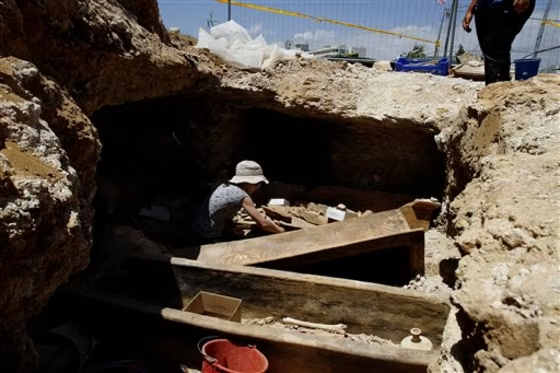
Work crews in Cyprus have accidentally unearthed four rare clay coffins estimated to be some 2,000 years old, the country's Antiquities Department director said Wednesday.
Maria Hadjicosti said the coffins adorned with floral patterns date from the east Mediterranean island's Hellenistic to early Roman periods, between 300 B.C. and 100 A.D.
She said the coffins were dug up this week from what is believed to be an ancient cemetery in the eastern coastal resort of Protaras.
Hadjicosti said similar coffins dating from the same period have been discovered. Two such coffins are on display in the capital's Archaeological Museum, while three others remain in storage there. But she called the latest find significant because the coffins were untouched by grave robbers.
"The undisturbed coffins will help us add to our knowledge and understanding of that period of Cyprus history," Hadjicosti said.
She said other items found at the site included human skeletal remains, glass vessels and terra cotta urns, indicating that the cemetery was in use over a long period of time.







 FOR SUBSCRIBERSA harrowing ordeal aboard an Israel-bound plane







FOR SUBSCRIBERSThe debate over AI’s future rages on both coasts

The official said the cemetery is one of several found throughout island's northeast, but scientists don't know which undiscovered settlement the bodies came from.
FOR SUBSCRIBERSA harrowing ordeal aboard an Israel-bound plane
FOR SUBSCRIBERSThe debate over AI’s future rages on both coasts
Crews stumbled on the coffins — or sarcophagi — while working to complete a sidewalk at the resort.
Excavations on Cyprus have uncovered settlements dating back to around 9000 B.C. Cyprus then saw successive waves of colonization, including Phoenicians, Mycenaean Greeks, Romans and, in the Middle Ages, Franks and Venetians. The island was conquered by Ottoman Turks in 1571 and became part of the British Empire in 1878 before winning independence in 1960.