The Phoenix lander will not rise again.
NASA declared the three-legged spacecraft officially dead Monday after repeated failed attempts to regain contact.
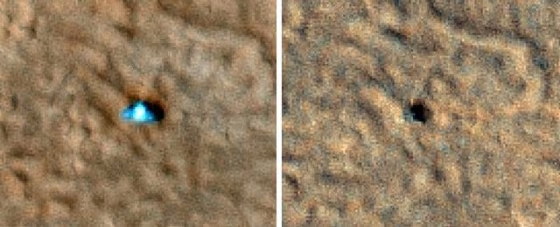
A recent image taken by an orbiting spacecraft appeared to show one of Phoenix’s solar panels had collapsed from ice buildup.
Phoenix landed near the Martian north pole on May 25, 2008, and successfully operated for five months — two months longer than planned — until sunlight at its far northern location waned.
Scientists did not expect it to survive the Martian winter but continued to listen for any signs of life.
“We had very little expectation of Phoenix recovering, but it’s one of those things we had to try even when the chances are slim,” said mission principal investigator Peter Smith of the University of Arizona in Tucson.
The Mars Odyssey orbiter flew over the Phoenix landing site more than 200 times this year in an attempt to regain communication. With spring arriving in the northern hemisphere last week, NASA tried again, but there was no response.
Earlier this month, an image taken by another spacecraft, the Mars Reconnaissance Orbiter, showed changes in Phoenix’s shadows, consistent with predictions that hundreds of pounds of carbon dioxide ice accumulating on the spacecraft could bend or break its solar panels.







 FOR SUBSCRIBERSA harrowing ordeal aboard an Israel-bound plane







FOR SUBSCRIBERSThe debate over AI’s future rages on both coasts

As the first spacecraft to land in the Martian arctic plains, Phoenix used its robotic arm to dig trenches in the icy soil. One of its early accomplishments was confirming the presence of water ice at its landing site.
FOR SUBSCRIBERSA harrowing ordeal aboard an Israel-bound plane
FOR SUBSCRIBERSThe debate over AI’s future rages on both coasts
The lander also detected traces of perchlorate in the soil. On Earth, the chemical can be found naturally in the Chilean desert where some extreme microbes use it as a source of energy. Long used in rocket fuel and other applications, perchlorate is now widely known as a water contaminant.
Phoenix was the first NASA robotic mission to use Twitter to communicate with the public. The tweets were courtesy of the Jet Propulsion Laboratory’s media relations office.
On Monday, this message appeared on Phoenix’s Twitter page: “From the team: Sleep well @MarsPhoenix. One chapter ends but more waits to be written with the science you returned.”