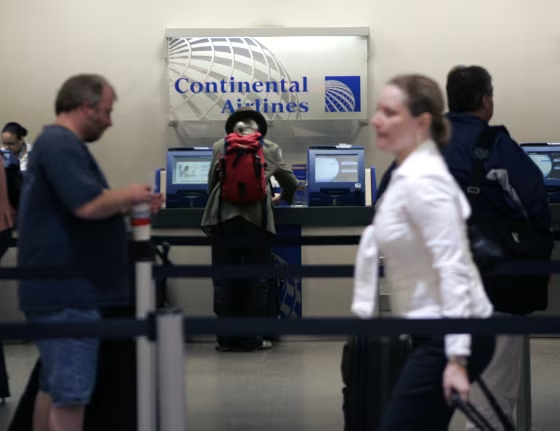
It’s the end of an era, although there’s a good chance you won’t even notice its passing. By the end of this year, the traditional magnetic-stripe boarding pass will become a thing of the past, joining the likes of Airphones, armrest ashtrays and free meals in coach.
The change, which is being overseen by the International Air Transport Association (IATA), spells the end of a system that was responsible for producing untold billions of specially designed boarding passes since it debuted in 1983. With 100-percent industry compliance expected by Jan. 1, IATA’s 230 member airlines will produce only the increasingly ubiquitous barcoded boarding passes.
What’s the big deal? “It’s not just getting rid of the mag-stripe,” said IATA spokesman Steve Lott. “Barcoded boarding passes opened up the door to a lot of other self-service options.”
Self-service six ways
For IATA, those options are all part of a larger initiative called Fast Travel, which comprises a suite of six self-service opportunities: check in, bag tagging, airline document checking (confirming ID at security will still be required), flight rebooking, boarding/emplaning and luggage recovery when bags go missing. By 2020, says Lott, IATA expects that 80 percent of global passengers will have access to the full suite of services.
The goal is two-fold: cost savings for the airlines — up to $2 billion per year worldwide — and more control for passengers who choose to handle the more mundane aspects of travel themselves. Said Lott, “How many times have you stood in a line thinking, ‘All I want to do is change my seat assignment and I’m standing here for half an hour while someone tries to rebook their trip around the world?’ ”
Several of the Fast Travel efforts are already well underway, although more so in Europe and Asia than in the U.S. According to IATA, passengers can use self-service channels to validate their travel documents on 16 airlines, self-tag their bags on 32 and self-board on 26. Supporters insist the data is not simply to foist more services onto passengers, but rather to better allocate resources where they’re needed.
Consider self-boarding, suggests Martin Riecken, spokesman for Lufthansa, which offers the option at its hubs in Frankfurt and Munich: “Instead of gate agents taking each boarding pass, scanning it and handing it back, they can work with those customers that actually need assistance.”
According to Riecken, the option can also speed up the boarding process, but usually only slightly. “You still have that bottleneck once you enter the plane,” he said. “That’s the multimillion-dollar challenge.”
Slower going stateside
Compared to Europe and Asia, North American airlines have been slower to roll out self-service options, at least beyond the basics of check-in/boarding pass retrieval. The major exception is Air Canada, which also offers self-bag tagging, except for U.S.-bound flights, and self-rebooking via a mobile app.

 FOR SUBSCRIBERSCBP leaders cut out of Trump ad buy decision









FOR SUBSCRIBERSA harrowing ordeal aboard an Israel-bound plane





FOR SUBSCRIBERSCBP leaders cut out of Trump ad buy decision
FOR SUBSCRIBERSA harrowing ordeal aboard an Israel-bound plane
In the U.S., progress has been even slower. Continental has been operating a single self-service boarding gate in Houston since the summer, while American has opted not to move forward with a proposed self-tagging pilot program at Boston’s Logan Airport. “We’re talking to a couple of other airports while we try to determine the right market to do the test,” said spokeswoman Stacey Frantz.
Before proceeding, they’d be advised to listen to the concerns of travelers, many of whom have expressed mixed feelings about self-service. “I love the convenience of printing my own boarding pass, but self-tagging luggage gives me pause for concern and opens up a Pandora’s box for misrouted and lost luggage,” said TV travel producer Marianne Schwab. “What’s next, asking passengers to engage the auto pilot?”
More phones, fewer kiosks?
Probably not, although more self-service options are already in the works. Qantas, for example, is currently testing a program at the Melbourne airport in which members of the airline’s loyalty program can wave an RFID-enabled card in front of a receiver to receive their itinerary, boarding pass and baggage tags in one fell swoop.
The service is currently limited to domestic travel within Australia, but according to Brian O’Rourke, global airlines leader for IBM, which developed the system, it may also signal the next great leap in self-service travel: “As smartphone technology improves, you may very well start to see fewer kiosk devices.”
Of course, kiosks aren’t going to go the way of mag-stripe boarding passes any time soon, but if the popularity of mobile boarding passes is any indication, it’s safe to say that self-service travel-management via cellphone is only going to grow. “The idea is not to eliminate customer service,” said Lott of IATA, “but to give people more options.”
And create less frustration, adds Andy Cunningham, chief marketing officer for Rearden Commerce Inc., developers of an e-commerce platform designed to integrate multiple applications across the entire travel experience. “The pain points in travel today are that these things aren’t all that easy to do — and they’re certainly not integrated,” she said. “The future is doing it all in one place.”
If that future also provides a way to eliminate that bottleneck on the Jetway, they’ll really be on to something.