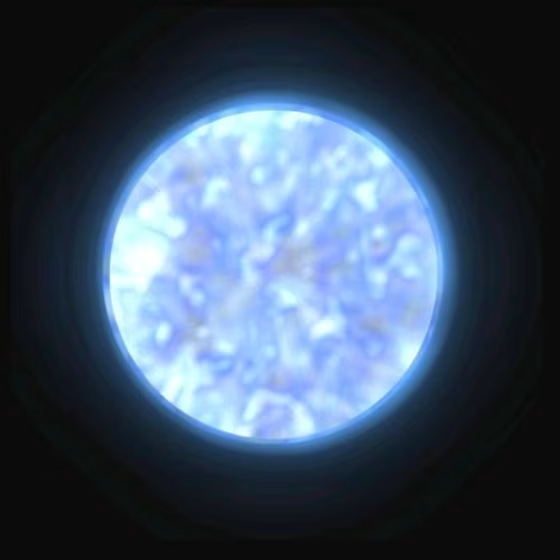
Meet LS IV-14 116. It's not the most memorable name for a star, but nonetheless, this star is very special.
Located some 2,000 light years from the sun, just between the constellations Capricornus and Aquarius, this star's atmosphere features glittery clouds of zirconium — more commonly known as "fake diamond." Other stars, like our Sun, might have trace amounts of zirconium — maybe one atom in two billion — but LS IV-14 116 has one zirconium atom for every 200,000 atoms.
How does such a rare object form in the first place? Most ordinary stars with insufficient mass to go supernova when they die — about 97 percent of all the stars in the Milky Way — will puff up into a red giant once they deplete their hydrogen fuel and start fusing helium into carbon and oxygen.
If a red giant is big enough (has sufficient mass), once it runs out helium it will move on to fusing other elements. If it's not massive enough, the star "stalls out," as it were. All that carbon and oxygen — byproducts of the helium fusion process — build up in its core. At that point the star will shed its outer layers and the core will form a white dwarf.
In rare cases, a star will shed its hydrogen layers prematurely during that first stage, before its core starts burning helium, and you end up with a helium-rich hot sub-dwarf, a progenitor to a white dwarf.
That's the class of star that Naslim and Jeffery were studying, hoping to ferret out clues as to why this category of star has so much less hydrogen on their surfaces than other similar stars.
They used spectroscopy for their analysis: a technique that breaks the light from celestial objects into a spectrum with telltale emission lines indicating which elements are present. (Each element has its own unique spectral pattern, like a chemical fingerprint.) That's how we know that hydrogen is the most abundant element in the universe, with helium close behind.
Naslim and Jefferey expected to see certain common elements, most notably hydrogen and helium, carbon, oxygen and the like. What they didn't expect: huge amounts of a form of zirconium that can only exist at temperatures above 20,000 degrees Celsius.
It's not a small excess either: there is 10,000 times more zirconium in LS IV-14 116 than in the sun. (There's also strontium, germanium and yttrium, between 1000 and 10,000 times more abundant than usual.) That translates to about 4 billion tons of zirconium here on Earth.
Those abundances were "a complete surprise," according to Naslim. That's why they titled their paper "An extremely peculiar hot sub-dwarf with a ten-thousand fold excess of zirconium, yttrium and strontium." They argue in their paper that all those extra elements comes from the formation of cloud layers in the star's atmosphere.

 FOR SUBSCRIBERSCBP leaders cut out of Trump ad buy decision









FOR SUBSCRIBERSA harrowing ordeal aboard an Israel-bound plane





FOR SUBSCRIBERSCBP leaders cut out of Trump ad buy decision
FOR SUBSCRIBERSA harrowing ordeal aboard an Israel-bound plane
Yes, stars can have atmospheres; that's typically the only part of a star we can see directly. In general, the heavier atoms in the atmosphere sink and the light ones remain at the surface, which is why some white dwarfs, for example, have mostly pure hydrogen or helium atmospheres. Under the atmosphere, scientists think there is a very think crust of carbon and oxygen.
What's unusual about LS IV-14 116 is the high concentration of metals heavier than calcium in those cloud layers. In fact, theoretical models of that atmosphere indicate that there could be several very thin cloud layers, each comprised of a different metal. The star might even be shrinking as it cools, causing various elements to float into the atmosphere or sink to the bottom — with that glittery zirconium layer front and center. I'll bet LS IV-14 116 doesn't even care that it isn't made of real diamonds.
Some day, millions of years from now, LS IV-14 116 will cool off to the point where it becomes a bona fide white dwarf. Those are amazing objects in their own right, and also rather rare (perhaps because they're so difficult to spot): there's eight known white dwarfs in the hundred nearest star systems to our sun.
What makes a white dwarf so amazing is that it has no internal source of energy — its core material is done with fusion — to counter gravitational collapse. So gravity just smashes all those atoms together until the electrons literally have nowhere to go. At that point, the star is so dense, it becomes "degenerate." And quantum mechanics literally stops that gravitational crunch in its tracks.
Eventually, LS IV-14 116 will radiate away enough energy to cool down until it won't emit enough heat to be visible at all. That's known as a black dwarf, but since the process takes longer than the present age of the universe, there are no known black dwarfs in existence. Maybe LS IV-14 will be the first.