The most massive stars in the universe can form essentially anywhere, even without other stars nearby, new observations suggest.
The scale of these hefty stars, which range from 20 to 150 times as massive as Earth's sun, is generally thought to be determined by the environment around them – usually a dense cluster of stars. The bigger the cluster, the more gas and dust available to forge giant stars.
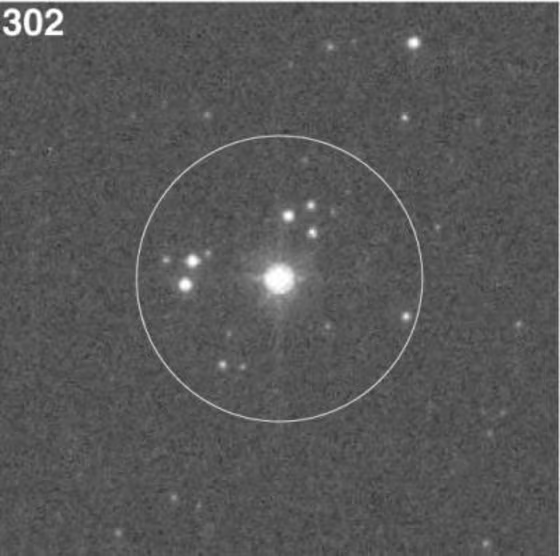
The new observations, made using the Hubble Space Telescope, support the opposing theory — that the most massive stars can be born randomly across the universe, including in isolation and in very small clusters. [Hubble Telescope Photo of one of the Isolated Stars]
Study team member Sally Oey evoked a personal memory in discussing the findings. "My dad used to fish in a tiny pond on his grandma's farm," Oey, of the University of Michigan, said in a statement. "One day he pulled out a giant largemouth bass. This was the biggest fish he's caught, and he's fished in a lot of big lakes. What we're looking at is analogous to this. We're asking: 'Can a small pond produce a giant fish? Does the size of the lake determine how big the fish is?' The lake in this case would be the cluster of stars. Our results show that you can, in fact, form big stars in small ponds."
The most massive stars direct the evolution of their galaxies. The wind and radiation streaming off them shape interstellar gas and promote the birth of new stars. Their violent supernova explosions create all the heavy elements that are essential for known life. Astronomers are still grappling to understand how these stars form — a process further complicated by their very short life spans and powerful winds.
In the new study, astronomers used Hubble to zoom in on eight such stars that appear from Earth's surface to be alone in space. These stars are in the Small Magellanic Cloud, a dwarf galaxy that's one of the Milky Way's nearest neighbors.







 FOR SUBSCRIBERSA harrowing ordeal aboard an Israel-bound plane







FOR SUBSCRIBERSThe debate over AI’s future rages on both coasts



Even from Hubble's viewpoint, five of the stars had no neighbors large enough to discern. The other three appeared to be in tiny clusters of 10 or fewer stars, according to the study, which is the most detailed to date of these massive stars.
FOR SUBSCRIBERSA harrowing ordeal aboard an Israel-bound plane
FOR SUBSCRIBERSThe debate over AI’s future rages on both coasts
The researchers acknowledged the possibility that some of the stars migrated from the neighborhoods they were born in. Two of the stars they examined are known to be runaways that have been kicked out of their birth clusters.
But in several cases, the astronomers found wisps of leftover gas nearby, strengthening the possibility that the stars are still in the isolated places where they formed.
The study is detailed in the Dec. 20 issue of the Astrophysical Journal.