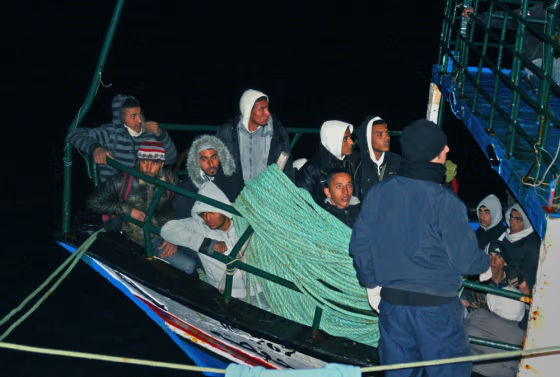
Italy warned Friday it faces a humanitarian crisis with some 1,600 would-be migrants from Tunisia arriving in its waters over the past two weeks following unrest in their home country.
Interior Minister Roberto Maroni said he had asked the EU to take up the matter at its next meeting, as the political crises in Tunisia and Egypt were affecting Europe's internal security.
The U.N. refugee agency said that since Jan. 16, some 1,600 Tunisians had arrived in Italy, mostly on the island of Lampedusa — closer to Africa than the Italian mainland. Half of them arrived in recent days.
Maroni, a member of the fiercely anti-immigrant Northern League, has said he fears Tunisian terrorists were among those who escaped Tunisian prisons and fled during a month of nationwide anti-government protests that forced dictator Zine El Abidine Ben Ali to flee on Jan. 14.
"There is the risk of a real and true humanitarian emergency," Maroni said.
The mayor of Lampedusa, Bernardino De Rubeis, brushed away Maroni' assertions that the migrants could include terrorists.
"What we're seeing is Tunisian youth escaping from the country after Ben Ali's fall," he told Italian television. "Many people say the migrants are criminals, given the mass escapes from North African jails in recent days, but looking at those faces I don't think that's what they are."

 FOR SUBSCRIBERSCBP leaders cut out of Trump ad buy decision









FOR SUBSCRIBERSA harrowing ordeal aboard an Israel-bound plane





The arrivals included 113 on a large boat and nine Tunisians who were rescued from a small dinghy before it sank.
Hundreds of migrants slept under open skies at Lampedusa's port, wrapped in space blankets, as they waited to be taken to holding centers. The surprise deluge of arrivals meant some migrants were put up in a hotel and a local priest threw open church facilities.
A smaller number of migrants also landed on another Italian island.
Controversial immigration policiesThe arrivals have alarmed Prime Minister Silvio Berlusconi's conservative government, which swept to power in 2008 promising a crackdown on illegal immigration and virtually halted seaborne migrant arrivals by striking a deal with Libya.
FOR SUBSCRIBERSCBP leaders cut out of Trump ad buy decision
FOR SUBSCRIBERSA harrowing ordeal aboard an Israel-bound plane
That deal said Italy would return would-be migrants without screening them first for asylum, drawing condemnation from the U.N. High Commissioner for Refugees. The UNHCR views the policy as a violation of would-be migrants' rights to seek asylum and flee oppression, humanitarian crises and war.
The policy, nevertheless, has worked in reducing the number of boat arrivals in Italy: In 2008, before it went into effect, about 36,000 migrants arrived illegally; by 2009 the number had fallen to 9,500, and in 2010 to 4,300, UNHCR said.
Maroni said Friday the surge in Tunisian arrivals stemmed from the political unrest, as a bilateral agreement to manage immigration was no longer being honored by Tunisia. He said he had approached the EU because Italy alone cannot be expected to deal with the influx.
Officials are also worried that the crisis in Egypt, where protesters have launched an uprising against President Hosni Mubarak, will provoke another wave of migrant arrivals.
'A real alarm'
Foreign Minister Franco Frattini said he would meet next week with new Tunisian Foreign Minister Ahmed Ounaies to discuss reactivating the immigration accords.
"It's a real alarm and we saw it coming," Frattini said. "We are in the presence of a true migratory emergency and we don't believe that Italy is the only place where they'll arrive and remain."
He said Europe should start thinking in longer terms for a "Marshall Plan" for affected countries of the region to stimulate their economies and provide opportunities for young people so they don't feel compelled to leave.
The UNHCR's Federico Fossi said in general the Tunisians who had arrived in Italy were seeking either asylum or temporary shelter while the situation in Tunisia remains tense, or were economic migrants.
He said U.N. refugee workers were arriving in Lampedusa on Friday to assess the situation. The island's immigration holding center has closed, so some migrants are being housed in hotels while others have been shipped to other centers.