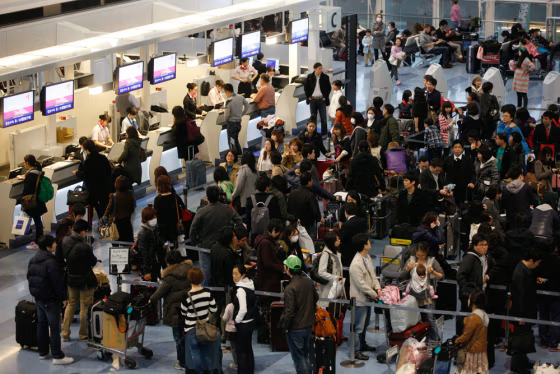
Airlines on Wednesday hustled to get passengers stuck at Tokyo's airports out of quake-stricken Japan, while aid organizations said the city is safe for international travelers.
Last week's earthquake and tsunami has transformed parts of Tokyo into a ghost town as people either stay indoors or leave.
France and Austria urged their citizens in Tokyo to leave the country or head to southern Japan. The French embassy in Tokyo said it had asked Air France to mobilize planes for the evacuation of French nationals from Japan, and two were already on their way.
An aviation industry official in Asia said there had been a sharp drop in demand to fly to Japan coupled with a rush to leave.
Briton Andy Beese, a Tokyo-based photographer, flew back to Tokyo late Tuesday from London on an Asiana flight.
"I've never been on such an empty flight," he said shortly after boarding. "It was a (300-seat Boeing) 777 with barely 20 people on board."
Not quite business as usual
While Japan's markets and banks remained open, many financial professionals, particularly those from outside Japan, were doing everything they could to get out of the country.
Foreign bankers choosing to remain in Tokyo and Japanese bankers said that it was anything but business as usual due to patchy communications, rolling blackouts, thinly staffed desks and so many people looking to leave.
"It's been almost impossible to get hold of investors since the quake hit," said one syndicate banker at a U.S. house from the safety of Hong Kong.
While the banks were not officially relocating people, they were accommodating employees and their families who wanted to leave.
"At the end of the day, it's the employee's choice whether they flee or stay back," a banker at a European investment bank said. Asked who was taking up the option to leave, he said: "Who isn't? Everyone is trying to get out. Wouldn't you?"
Expatriate staff at most foreign banks in Tokyo make up a small portion of the total, by some estimates less than 10 percent. But many are often in senior positions so their departure can have a significant impact.
And while Japan's investment banking market is famously tough, it's an essential place for large banks to be and can produce hefty fees.
"The foreign banker presence on the ground in Tokyo now is very thin, and depending on how long it takes them to return, there could be lasting implications of that," said one banker. "Every time there's a washout of foreigners in Japan, they never quite return in the same numbers."
Several bankers compared the situation to the outbreak of SARS in 2003. Severe Acute Respiratory Syndrome (SARS) emerged in southern China in 2002, swept through Guangdong province and Hong Kong before spreading globally in 2003. It infected some 8,000 people and killed around 800, which prompted hordes of foreign professionals to leave Hong Kong.
Private jets become popularThe demand for private jets was growing, according to CNBC. Private jet operators said they’re seeing a surge in demand for flights to help evacuate foreign bankers and company CEOs.
One jet operator told CNBC the cost of flying 14 people to Hong Kong from Tokyo, a 5-hour flight, was more than $160,000.
"I got a request yesterday to fly 14 people from Tokyo to Hong Kong," Jackie Wu, COO of Hong Kong Jet, told CNBC. "They did not care about price."
While most airlines are right now coping with flight demands and safety advice on a daily basis, some experts are already trying to assess the long-term impact on Japan's travel and tourism industry.
"The airlines will be adjusting day by day to cope with the after-effects of the quake, but longer term, they will be evaluating the market to see what their operations should be before changing their schedules," said Alistair Rivers, Director of Industry Affairs at Innovata, a U.S. company specializing in the management and distribution of flight databases.
The International Air Transport Association (IATA) said the Japanese disaster would reduce premium air travel in March as Japan makes up 6-7 percent of the global market.

 FOR SUBSCRIBERSCBP leaders cut out of Trump ad buy decision









FOR SUBSCRIBERSA harrowing ordeal aboard an Israel-bound plane





FOR SUBSCRIBERSCBP leaders cut out of Trump ad buy decision
FOR SUBSCRIBERSA harrowing ordeal aboard an Israel-bound plane
The World Travel & Tourism Council estimates travel and tourism made up 6.8 percent of Japan's 2011 GDP before the quake, although growth forecasts for 2011 were now in doubt.
Travel company Inside Japan Tours, which sent around 4,000 people to the country last year, said some people had canceled trips after official British advice not to travel there.
A spokesman for the company, which has been providing a stream of updates on its Facebook page, said however, that the majority of people were so far looking to take up its offer of rebooking trips past May 15.
"This is promising and shows they're not giving up on us or Japan," he added.
On thin ice?
International skating officials are still waiting for a response from Japanese organizers, but may have to decide on their own what to do about the world figure skating championships scheduled to begin Monday in Tokyo.
International Skating Union president Ottavio Cinquanta told The Associated Press that he sent a letter to Japanese organizers Tuesday asking if they would be capable of hosting the championships in several months.
"We're not closing the door in the face of the Japanese, but we need to know, and the skaters need to know. We are still waiting for a reply," Cinquanta said Wednesday from his Milan office. "If we don't hear anything in another two or three days, we're going to have to make the decision ourselves."
Cinquanta said the ISU is considering three options: Japan hosting the worlds at a later date, moving the championships to another country, or canceling them altogether.
Red Cross: Tokyo is safe
The Japanese Red Cross, along with the International Federation of Red Cross and Red Crescent Societies (IFRC), said Wednesday that Tokyo is safe for international travelers.
"The Japanese Red Cross is telling us that Tokyo is safe, as far as nuclear radiation is concerned, and that foreigners can come in to travel," said Senior IFRC official Matthias Schmale.
He said the situation was changing all the time, but that the Geneva-based IFRC, which links to Red Cross and Red Crescent societies around the globe, had implicit trust in the Japanese society and its information.
Passing out pills
Thai authorities say they will distribute medicine to citizens traveling to Japan to protect against radiation from damaged nuclear power plants.
The Health Ministry says that beginning Thursday, potassium iodide tablets will be given free to travelers flying to Tokyo from airports in Bangkok and Phuket. The government already warns against unnecessary travel to Japan.
Potassium iodide protects the thyroid gland against cancer by blocking absorption of radioactive iodine. Supplies in Japan have become short, and panic buying has been reported as far away as North America.
The government's National News Bureau says more than 70 percent of package tour bookings to Japan for March to May have been canceled.
Reuters and the Associated Press contributed to this report.