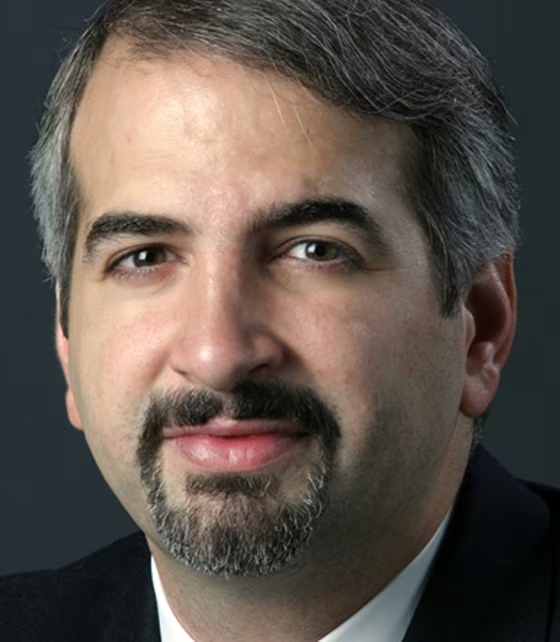
Four journalists covering the fighting in Libya for the New York Times are missing, the newspaper said Wednesday.
The New York Times said the journalists, who included two-time Pulitzer Prize winner Anthony Shadid, were last in contact with their editors Tuesday morning as they covered the rebels' retreat from the town of Ajdabiya.
Also missing were Stephen Farrell, a reporter and videographer who was kidnapped by the Taliban in 2009 and rescued by British commandos, and two photographers, Tyler Hicks and Lynsey Addario, the newspaper said.
"We have talked with officials of the Libyan government in Tripoli, and they tell us they are attempting to ascertain the whereabouts of our journalists," Bill Keller, the executive editor of The New York Times, said in a statement.
The Times said there were unconfirmed reports that Libyan forces had detained the foursome. He said the Libyan government had assured the Times that if the journalists have been captured, they would be released promptly and unharmed.
The White House on Wednesday urged the Libyan government to refrain from harassing or using violence against journalists. Obama spokesman Jay Carney said the United States is firm in its belief that journalists should be protected and allowed to do their work.
Pro-Gadhafi forces have largely gained control of Ajdabiya after two days of relentless shelling but still face pockets of resistance in the city of 140,000 people. Habib al-Obeidi, a doctor at Jalaa Hospital in Benghazi, said that a colleague in Ajdabiya had told him 25 people were killed when pro-Gadhafi forces opened fire on civilian cars fleeing the city. That report could not be independently confirmed.
The breakdown in rebel defenses in Ajdabiya threatened to open the gateway to the long stretch of eastern Libya that has been in the control of the opposition, including Benghazi, Libya's second-largest city and the de facto capital of the opposition.
Shadid's father, Buddy Shadid, said he last spoke to his son on Monday. The reporter was tired and living on cans of tuna, but had planned to spend another week covering Libya.
"I told him it's so crazy there, no one knows who's friend, who's foe. But he said he knew what he's doing, not to worry," Buddy Shadid said. "We're all just praying for his safety."
All four Times journalists are experienced war correspondents.
Shadid previously worked for the Washington Post, The Associated Press and the Boston Globe. He won the Pulitzer Prize for international reporting in 2004 and 2010 for his coverage of Iraq.
 FOR SUBSCRIBERSCBP leaders cut out of Trump ad buy decision









FOR SUBSCRIBERSA harrowing ordeal aboard an Israel-bound plane





Hicks, a former photographer for the Troy Daily News in Ohio and The Wilmington Star-News in North Carolina, had worked in hotspots from Haiti to Chechnya. He was named Newspaper Photographer of the Year in 2007 by Pictures of the Year International and won an Infinity award from the International Center of Photography in 2001.
FOR SUBSCRIBERSCBP leaders cut out of Trump ad buy decision
FOR SUBSCRIBERSA harrowing ordeal aboard an Israel-bound plane
Addario was part of the New York Times team that won the 2009 Pulitzer Prize for international reporting and also has worked for National Geographic and Time magazine. She won a MacArthur Fellowship, or "Genius Grant," in 2009.
In September 2009, Farrell and Sultan Munadi, an Afghan journalist and interpreter who worked regularly with the Times and other news organizations, were taken hostage when they went to cover the aftermath of a NATO airstrike that killed scores of civilians in northern Afghanistan.
Munadi and a British commando died in the raid that rescued Farrell, a Briton.
Farrell also was kidnapped in 2004 in Fallujah, Iraq. He previously worked for the Times of London.
On Saturday an Al-Jazeera cameraman was killed and a correspondent wounded when their car was ambushed near Benghazi.
Earlier this month, Libyan authorities detained reporter Andrei Netto of Brazil's Estado de S. Paulo newspaper for several days. The Libyan government said he was arrested because of mistakes he made on forms he filled out to enter Libya. A journalist from Britain's Guardian newspaper remains missing.
In February, CBS said its reporter Lara Logan was attacked and sexually assaulted while covering reaction to Egyptian President Hosni Mubarak's resignation.
A BBC news team also said last week it had been detained by Libyan security forces, beaten and subjected to mock execution after they were arrested at a checkpoint.
Libyan leader Moammar Gadhafi, in power since a military coup in 1969, lost control of large swathes of Libya in a revolt last month, but since then his security forces have fought back. The Libyan uprising follows popular uprisings that ousted the presidents of Tunisia and Egypt.