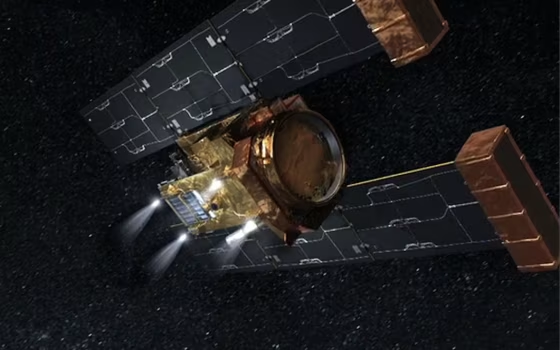
NASA ordered its comet-hunting Stardust probe to burn its remaining fuel on Thursday, setting off a series of events that shut down the spacecraft after a 12-year career.
Engineers gave the order Thursday afternoon from Lockheed Martin's Denver complex, where Stardust was built. Shortly after 5:30 p.m. MT (7:30 p.m. ET), ground controllers lost radio contact with the space probe for the last time.
Stardust performed one last experiment by telling engineers how much fuel it had left at the end. That will tell them how accurate their fuel calculations were and help with the design of future probes. Spacecraft don't carry fuel gauges because such equipment doesn't work in zero gravity.







 FOR SUBSCRIBERSA harrowing ordeal aboard an Israel-bound plane







FOR SUBSCRIBERSThe debate over AI’s future rages on both coasts

For the record, the final burn lasted for 146 seconds.
"This kind of feels like the end of one of those old Western movies where you watch the hero ride his horse toward the distant setting sun — and then the credits begin to roll," the Stardust mission's project manager, Tim Larson, said in a NASA statement. "Only there's no setting sun in space."
FOR SUBSCRIBERSA harrowing ordeal aboard an Israel-bound plane
FOR SUBSCRIBERSThe debate over AI’s future rages on both coasts
Stardust was launched in 1999. It completed its primary $300 million mission in 2004 by flying through a cloud of dust and gas enveloping the Wild 2 comet and capturing samples. Those were sent to Earth for study via a parachute-equipped canister.
NASA then recycled Stardust, sending it past Comet Tempel 1 last month as part of a $29 million follow-up mission called Stardust-NExT. The exercised was aimed at seeing how Tempel 1's surface has changed since the Deep Impact mission went past in 2005.
More Stardust memories:
This report was supplemented by msnbc.com.