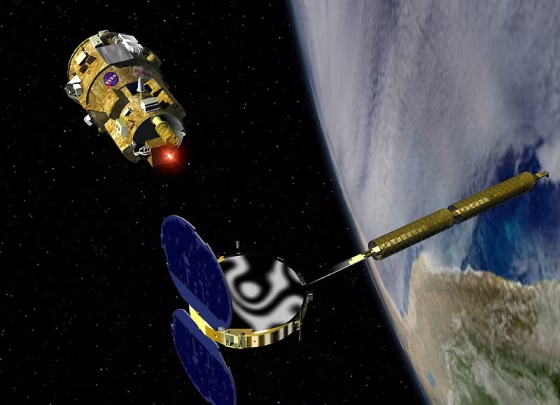
The NASA-sponsored Demonstration of Autonomous Rendezvous Technology program is progressing to an in-space experiment later this year.
DART is to shake out the hardware needed for a spacecraft to locate and rendezvous with another spacecraft without direct human guidance. That ability is central to future space initiatives, such as Mars sample return, crew and cargo delivery to the international space station, and satellite inspection, retrieval and servicing missions.
The DART concept should also provide expertise in deorbiting the Hubble Space Telescope. Current plans call for a rocket booster to attach to the observatory under remote control. That motor would then ignite to dump the observatory precisely into a remote stretch of ocean here on Earth.







 FOR SUBSCRIBERSA harrowing ordeal aboard an Israel-bound plane







FOR SUBSCRIBERSThe debate over AI’s future rages on both coasts

Orbital Sciences Corp. of Dulles, Va., is leading the DART effort. The work is contracted by NASA’s Space Launch Initiative at Marshall Space Flight Center in Huntsville, Ala.
To be powered into space by Orbital’s Pegasus XL air-launched booster, the DART uses an Advanced Video Guidance Sensor to approach and circumnavigate a target satellite.
FOR SUBSCRIBERSA harrowing ordeal aboard an Israel-bound plane
FOR SUBSCRIBERSThe debate over AI’s future rages on both coasts
DART is now slated for a mid-October launch from the Vandenberg Air Force Base in California.
DART’s target is the 105-pound (48-kilogram), Orbital-built Multiple Beam Beyond Line-of-sight Communications satellite, launched back in 1999. The DART spacecraft is to pull up to the target under autonomous control, closing within 16 feet (5 meters) of the low-Earth-orbiting satellite.
Only the Russian Space Agency has developed and demonstrated an autonomous spacecraft rendezvous capability, Orbital points out.