Greek Prime Minister George Papandreou survived a confidence vote in parliament early Wednesday, winning a gamble on his government's survival and the danger of a devastating debt default that could spark a financial maelstrom around the world.
Papandreou won 155 votes to 143, with two abstentions in the 300-member legislature to face down an internal party revolt and help him pass deeply disliked austerity measures that have provoked strikes, protests and a slump in his popularity.
The vote was conducted by roll call after a heated debate that saw sections of the opposition briefly walk out. All deputies voted along party lines.
A loss would have likely led to early elections and thrown into question whether Greece could pass the new austerity bill by the end of June as demanded by the country's international creditors.
Unless the new measures pass, Greece will not receive the next batch of funds from its bailout loans, and will face a disastrous default.
Greece is being kept financially afloat by 110 billion euros ($157 billion) EU-IMF bailout fund.
A default by Greece could drag down Greek and European banks as well as stoking renewed fears over the finances of other eurozone countries, such as Portugal, Ireland and Spain.
Expectations that Papandreou would win lifted world markets. His Socialist party holds a five-seat majority in the 300-member legislature.
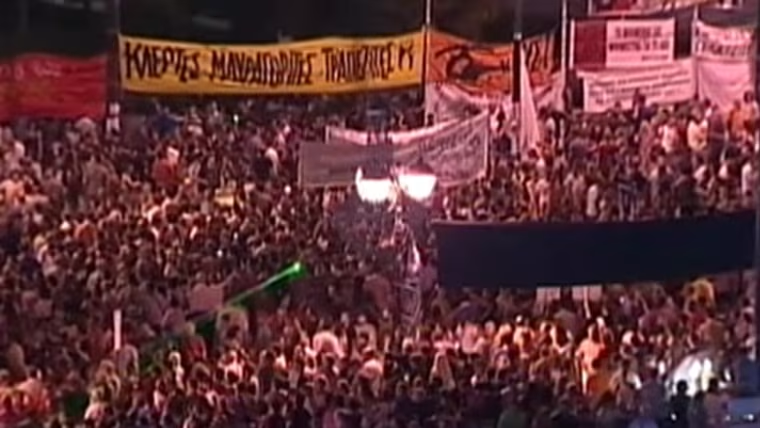
After the vote, riot police fired tear gas and stun grenades to push back a group of about 200 protesters who had broken off from a main rally of several thousand to throw bottles and other objects at the police lines guarding Parliament.
"We will do everything in our power to end the state of insecurity face Greek families and exit this crisis in a safe way. We have a plan, we have prospects," Papandreou said during a debate before his victory. "Regardless of the panic caused by some, we are on an organized course, helped by the international community with massive loans — the largest every given in the history of our planet."
Papandreou reshuffled his Cabinet last week and replaced his finance minister to ease growing dissent within the governing party.
On Tuesday the new finance minister, Evangelos Venizelos, promised that parliament will pass the unpopular austerity package by the end of June in order to comply with European Union demands to receive the next payment in its bailout loan.
Venizelos said Parliament is set to vote on 28 billion euros ($40.2 billion) worth of budget cuts and other savings next week.
Greece has said it will face a default unless it receives the 12 billion euros ($17.3 billion) rescue loan installment from European countries and the International Monetary Fund.
"We must follow this course to save the country," Venizelos said.
"Our European partners ... face is with distrust," he said. "This is an atmosphere that we have to change."
Greece's European creditors have also intensified pressure on the country's main opposition party to back the austerity, particularly as the new bill runs to 2015, two years beyond the current government's mandate.
'Austerity program simply will not work'
But opposition leader Antonis Samaras repeated Tuesday night that he will not back the program because he believes it is not working.







 FOR SUBSCRIBERSA harrowing ordeal aboard an Israel-bound plane







FOR SUBSCRIBERSThe debate over AI’s future rages on both coasts

"We mean what we say. We will not give consensus to a mistake," he said during the debate on the confidence motion. "The austerity program, simply will not work. It did not work because it is the wrong recipe. It's not implementation that's the problem, it's the recipe."
FOR SUBSCRIBERSA harrowing ordeal aboard an Israel-bound plane
FOR SUBSCRIBERSThe debate over AI’s future rages on both coasts
Samaras has said he backs efforts to cut the deficit and debt, but insists this must be done by revitalizing the economy and cutting taxes.
Papandreou's popularity has been hammered by the latest austerity measures, with an opinion poll published Tuesday giving the Socialists a 20.1 percent approval rating. Rival conservatives faired marginally better, at 21 percent, in the GPO survey for private Mega television of 1,000 adults. No margin of error was given.
As deputies voted, several thousand protesters gathered outside Parliament chanting "Thieves! thieves!", shining green laser lights at the parliament building and into the eyes of riot police protecting it. Continuing strikes by electricity company workers objecting to privatization caused a second day of rolling blackouts.
"I understand the anger, the fear, and the question whether we will make it," Papandreou said. "My answer is that we have been making it every day for the last 20 months, with difficulties and mistakes, with a price to pay and with sacrifices but we are succeeding."
Socialist skeptics, however, appeared to shy away from another fight.
Prominent dissenter Nikolas Salagiannis, said he would vote in favor of the government following the cabinet reshuffled.
"This has generated a slim hope that the issues can be addressed ... We back the new government," Salagiannis said. But he added: "Make no mistake, our connection with people in the street and in the squares is dwindling by the day. We have gone from austerity to more austerity, from denial to denial to get where we are ... and the public's tolerance has been used up."
But even after winning, Papandreou faces an even more difficult task: Getting parliament to back the new austerity measures as well as an unpopular 50 billion euros ($71 billion) privatization program by the end of the month.
If the new austerity measures pass, the finance ministers of the 17-nation eurozone will meet July 3 to give Greece its next bailout installment.
A key requirement from the eurozone and the IMF is that Greece steps up its privatization drive.
European officials are also discussing a second, similar-sized bailout for Greece since it's obvious the country won't be able to return to the bond markets and raise money to pay creditors any time soon.
"I trust that the new Greek government will receive the confidence of parliament," European Commission President Jose Manuel Barroso said after meeting with Papandreou Monday, but added the crucial vote was the one on the new austerity package.
"I therefore trust that Greece's elected representatives will back these measures next week in a spirit of national and indeed European responsibility," Barroso said. "These choices are not easy, but nor are the problems that need to be addressed. Now is not the time to falter."