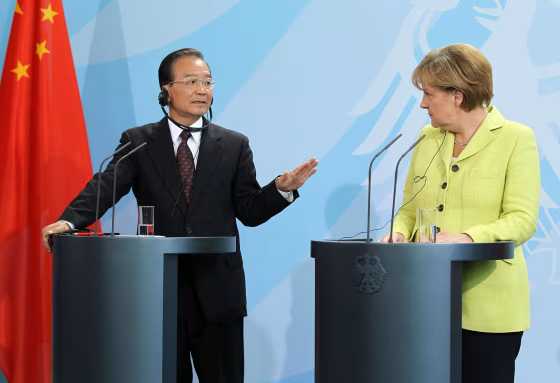
Chinese Premier Wen Jiabao today said China may give Europe "a helping hand" with its current debt crisis — but warned in uncharacteristic tones for a second successive day against European officials and media that "meddle" in China's affairs.
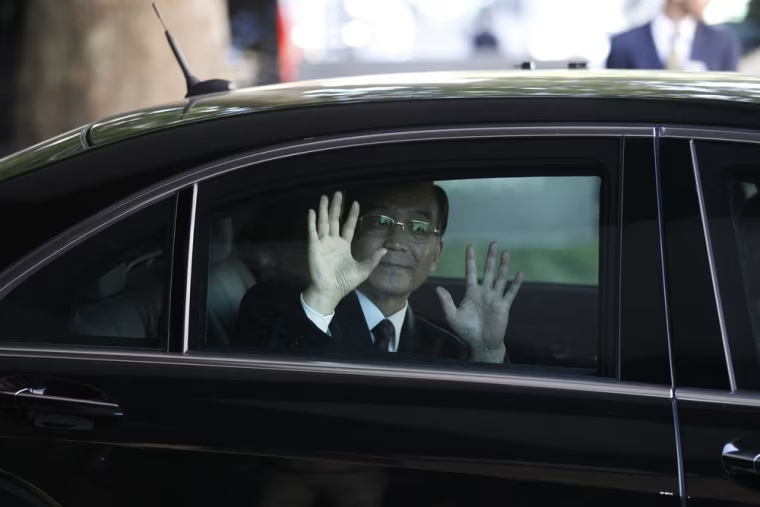
Mr. Wen, seen as one of China's more liberal and sympathetic senior officials, ended a goodwill jaunt through Europe that is partly intended to put a better face on China, experts say, and meant to keep Sino-European business flowing during a US election season that could result in significant China-bashing.
His trip included a stop in Hungary, head of Europe's rotating presidency, where he offered $1.4 billion in loans. A visit to England showcased Wen's interest in Shakespeare, and brought $2.3 billion in trade deals. In Germany, a nation that designs many of the machine tools China has used to become the "factory of the world," trade deals totaled more than $14 billion.
Yet Wen caused a shock in London on Monday by sharply admonishing the Tory government of Prime Minister David Cameron for raising dissident cases, saying that 5,000 years of history "has taught the Chinese never to talk to others in a lecturing way." In Berlin, he repeated his government's desire not to be upbraided by moral or legal representations.
Ahead of the trip and to set a good tone, China released artist Ai Weiwei and activist Hu Jia, two dissidents widely admired in Europe. Yet Cameron raised four prominent cases of dissidents detained under extrajudicial circumstances; Ai Weiwei and Hu Jia were among those noted. In Berlin, Wen said that Chinese leaders "expect from the EU respect of our sovereignty, our territorial integrity, and the autonomous choices of the Chinese people."
Kerry Brown, head of the Chatham House Asia Program in London, says that Chinese leaders view dissidents as criminals pure and simple and that both Wen and Cameron have "constituencies they must please ... the hard-liners are in control in Beijing right now."







 FOR SUBSCRIBERSA harrowing ordeal aboard an Israel-bound plane







FOR SUBSCRIBERSThe debate over AI’s future rages on both coasts

FOR SUBSCRIBERSA harrowing ordeal aboard an Israel-bound plane
FOR SUBSCRIBERSThe debate over AI’s future rages on both coasts
"But it is still frustrating for the Chinese that have worked hard and put much effort into trying to understand the West and Europe, and then to be asked only about human rights. The phrase 'human rights' has become ideological," he says.
It has been a difficult year for China’s image abroad as Beijing continues to pursue a more assertive or even hard-line policy in its neighborhood and abroad.
After nearly a decade of describing its policy in Asia as one of a "peaceful rise," China has been throwing elbows and making threatening gestures. A year of decisions in Beijing have raised eyebrows around the world.
China decided to keep writer and activist Liu Xiaobo incommunicado and in prison during the Nobel Peace Prize ceremony in his honor. It has raised tensions with Vietnam over rights in the South China Sea, and has done little as North Korean leader Kim Jong Il has nuclearized the Korean peninsula.
"Just as June 4 [1989] in Beijing ended many illusions about the nature of the Communist Party of China, so events of the past year have stripped away many illusions about the country's 'peaceful rise,'" says respected Asian columnist Philip Bowring in Hong Kong. “No longer does the region assume that peace is a given and Chinese economic growth will not create other problems. Instead, the focus is on managing conflicts and attempting to allay mutual suspicions through dialogue."
This article, first appeared on CSMonitor.com.