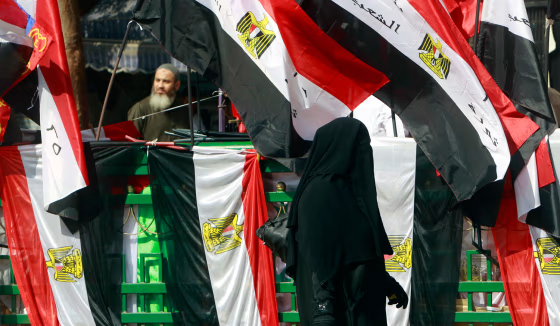
New ministers in an Egyptian cabinet reshuffle will take the oath of office Thursday, amid growing popular anger at the military government's handling of the transition to civilian rule.
Around half of the interim cabinet is being changed including the foreign affairs and finance portfolios, the cabinet announced.
The investiture will take place Thursday morning in the presence of Field Marshal Mohamed Hussein Tantawi, head of the ruling military council.
It was delayed after Prime Minister Essam Sharaf was hospitalized with low blood pressure Monday as he tried to finalize the new ministerial line-up. He left the hospital later that day after his condition was declared stable.
Protesters camped out in Cairo's Tahrir Square have demanded faster political and economic reforms, a swift move to democratic civilian rule and the removal from government of members of deposed President Hosni Mubarak's party.
Some protesters welcomed a shake-up last week of top police officers by Interior Minister Mansour el-Essawy, who keeps his post in the reshuffle. Others say he has not done enough to end a culture of thuggery and impunity in the security forces.
The protests in the capital have increasingly targeted the army council which is accused of delaying Mubarak's trial and being too slow to remove officials from the old administration.
'Dismantle the revolution'
Protesters cite the widespread use of military courts to try civilians, a common practice under the ousted president and since adopted by the army council led by Tantawi, who was Mubarak's defense minister for two decades.
"There are thousands of youth held in military prisons simply for the reason that they were on the street at the wrong time. It's a plan to dismantle the revolution. If they arrest some, others will be scared to go protest," said actor Aly Sobhy, who was acquitted by a military court in a 20-minute trial after being held in custody for four days.
Even under Mubarak, civilians subjected to military trials were often suspects in security cases, particularly during an armed Islamist uprising in the 1990s, not common criminals.
Rights groups and activists say the wholesale use of military trials in the last few months calls into question the willingness of the army council, which took over after Mubarak resigned in February, to transform Egypt into a democracy.
The military says such trials are reserved for serious crimes and not to quash freedom of expression. But activists and rights groups point to at least six incidents of random arrests to disperse demonstrations in the past few months.
"The military has shown itself to be guilty of many of the same practices used under the Mubarak regime," said Shadi Hamid, director of research at Brookings Doha Center.







 FOR SUBSCRIBERSA harrowing ordeal aboard an Israel-bound plane







FOR SUBSCRIBERSThe debate over AI’s future rages on both coasts

"Being condemned to prison for protesting is the complete opposite of what people are calling for in Tahrir Square," Hamid said.
'Emergency situation'
Rights groups say the trials undermine the rule of law and hinder an orderly transition, arguing that it was better to use the civilian judicial system, despite its flaws and slower pace.
At least 10,000 civilians have faced military trials since the uprising that toppled Mubarak, according to Human Rights Watch, Amnesty International and other rights groups.
FOR SUBSCRIBERSA harrowing ordeal aboard an Israel-bound plane
FOR SUBSCRIBERSThe debate over AI’s future rages on both coasts
Charges vary from petty theft to violent crime. Sentences can be tough. A shop-owner was sentenced to seven years in jail after a tribunal convicted him of stealing four pairs of shoes and a mobile phone card. He denied the charge.
The army accepts the principle, enshrined in international law, that military courts should not try civilians, but says they are needed temporarily to handle Egypt's security problems.
"No civilian should be tried in front of military courts," Gen. Mamdouh Shaheen of the ruling military council told reporters. "But in this emergency situation ... military courts took the place of civilian courts until they were able to work."
In response to criticism, the generals have now offered a contact numbers for queries and complaints on past convictions. For Sobhy and others, such offers are inadequate.
"Their insistence on defending military justice is a problem," Adel Ramadan, a human rights lawyer with the Egyptian Initiative for Personal Rights, said. "This is a policy that the armed forces has adopted and it is not willing to give it up."
Swift justice?
Military courts, which often deal with groups of five to 30 defendants in a single trial lasting 20 to 40 minutes, have given out sentences ranging from six months to 25 years, on charges of breaking a curfew, possession of illegal weapons, destruction of property, theft or assault.
Defendants in military trials, closed to the public, often have no access to counsel of their own choosing, except in high-profile cases such as the blogger Maikel Nabil, 26, sentenced to three years in prison for insulting the military establishment.
"My brother called me and told me his trial was about to start in 30 minutes. Where is the fairness in that?" Mark Nabil, the blogger's younger brother, said. He then alerted rights group and the media, and found counsel for his brother.
The military judge told Nabil's lawyers that the ruling had been postponed at their request and ordered them to leave the court. They later discovered he was convicted in their absence.
"The military council arrests anyone they feel like arresting, accuses them of being thugs, and in 10 hours, they can convict them to a three-year sentence," Mark Nabil said.
Rights groups say the trials undermine the civilian justice system during the transition period the army is overseeing.
"I regret the fact that there isn't more focus on the substance of transition," Heba Morayef of Human Rights Watch said. "We are being left with a very serious legacy and a challenge to the rule of law and the independence of judiciary."
Under emergency laws that gave Mubarak's Interior Ministry sweeping powers of arrest, 10,000 to 14,000 people were incarcerated without fair trial. Rights groups worry that the laws are still being used to round people up unfairly.
"What we may have done is remove the ministry of interior and replaced it with the military," said Morayef.