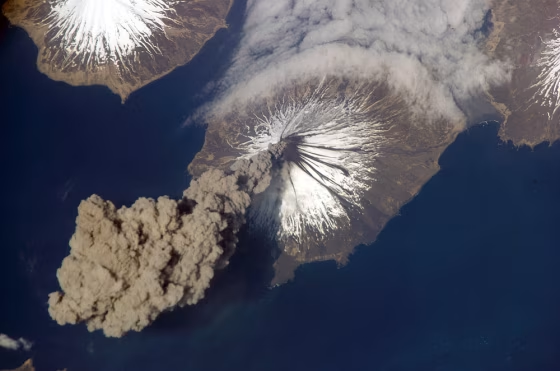
Recent satellite images of a remote Alaska volcano along a flight route for major airlines show it may be poised for its first big eruption in 10 years, scientists said.
The Alaska Volcano Observatory has issued an eruption advisory for the 5,676 foot-tall Cleveland Volcano, located on the uninhabited island of Chuginadak in the Aleutian chain about 940 miles southwest of Anchorage.
The advisory was based on "thermal anomalies" detected by satellite, the observatory said on Thursday. Those measurements indicate the volcano could erupt at any moment, spewing ash clouds up to 20,000 feet above sea level with little further warning, the observatory said.
A major eruption could disrupt international air travel because the Cleveland Volcano, like others in the Aleutians, lies directly below the commercial airline flight path between North America and Asia, said John Power, scientist-in-charge at the Alaska Volcano Observatory.
The volcano's last major eruption came in 2001, when it blasted ash more than 5 miles into the sky and spilled lava from the summit crater. Cleveland has experienced several smaller eruptions or suspected eruptions since then.
So far, airlines have not changed their flight patterns because of Cleveland's heat emissions, said Steve McNutt, a University of Alaska Fairbanks scientist who works at the observatory.
Scientists are not always certain about what is happening at the remote volcano, observatory officials said. The town of Nikolski, the nearest settlement to the Cleveland Volcano, is 45 miles away.







 FOR SUBSCRIBERSA harrowing ordeal aboard an Israel-bound plane







FOR SUBSCRIBERSThe debate over AI’s future rages on both coasts

Although Cleveland is among the most active of Alaska's roughly 90 volcanoes, no seismic equipment is set up there because the costs of working in such a remote area are prohibitive, observatory officials said.
FOR SUBSCRIBERSA harrowing ordeal aboard an Israel-bound plane
FOR SUBSCRIBERSThe debate over AI’s future rages on both coasts
Still, Cleveland is the only Alaska volcano blamed for an eruption-caused human death in recorded history. A U.S. soldier who was stationed on Chuginadak Island during World War Two disappeared during an eruption and was presumed killed.
Without sophisticated monitors like those used to keep tabs on volcanoes closer to Anchorage and other populated areas, scientists must rely on a variety of other observations to track Cleveland's eruptions, McNutt said. Those include satellite data, eyewitness reports and video from mariners and pilots in the area.
"Cleveland is a particular bugaboo for us because it is right on the air route" with no seismic equipment, Power said.