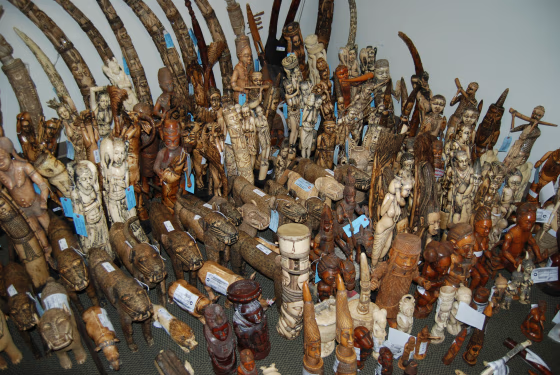
Federal officials seized roughly a ton of ivory in one of the largest U.S. seizures on record and arrested the owner of an African art store accused of smuggling carved elephant tusks into the United States, authorities said Tuesday.
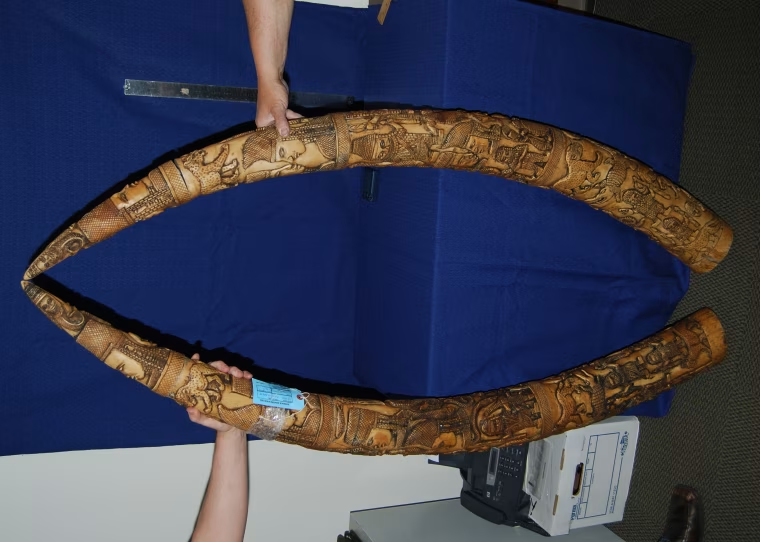
Victor Gordon, 68, pleaded not guilty in U.S. federal court in Brooklyn to charges of conspiracy, smuggling and violating the Lacey Act, an anti-trafficking law aimed at curbing illegal shipments of protected wildlife, including ivory from elephants and rhinos.







 FOR SUBSCRIBERSA harrowing ordeal aboard an Israel-bound plane







FOR SUBSCRIBERSThe debate over AI’s future rages on both coasts

FOR SUBSCRIBERSA harrowing ordeal aboard an Israel-bound plane
FOR SUBSCRIBERSThe debate over AI’s future rages on both coasts
The indictment said Gordon paid a partner to purchase raw elephant ivory in west and central Africa and have it carved to his specifications. He also told the partner to dye or stain the carvings to make them look older than they were and to ship them to his Philadelphia art store, prosecutors said.
Authorities seized hundreds of tusks sold or owned by Gordon in Philadelphia and other places in Pennsylvania, and in New York, Missouri and Kansas, according to the indictment, in what was described as among the largest U.S. seizures of elephant ivory on record.
"The amount of the elephant ivory allegedly plundered in this case is staggering and highlights the seriousness of the charged crimes," said Loretta Lynch, U.S. Attorney for the Eastern District of New York.
If convicted on all charges, Gordon faces a maximum of 20 years in prison. He has been released on $1 million bail.
African elephants are listed as a threatened species under the U.S. Endangered Species Act. Importing, buying or selling African elephant ivory brought into the United States after 1989 is illegal unless the items are more than 100 years old.
The law was intended to protect African elephants from the high global demand for ivory, which led to devastating and widespread poaching, particularly in the 1970s and 1980s, officials said.
At a news conference in Philadelphia, authorities displayed what they said was roughly $1 million worth of intricately carved tusks at the center of the case.
"It is shocking. It is depressing. It is enraging," said Richard Ruggiero of the Fish and Wildlife Service.
Illegal ivory trading was largely responsible for a sharp decline of the elephant population in much of Africa, he said. In the Democratic Republic of Congo alone, the elephant population in 1979 was 350,000 to 400,000 but now is only about 12,000 to 15,000, he said.
Although the United States has implemented steps to crack down on the illegal ivory trade, officials said, prices and demand continue to create a market for the banned goods in international and domestic markets.