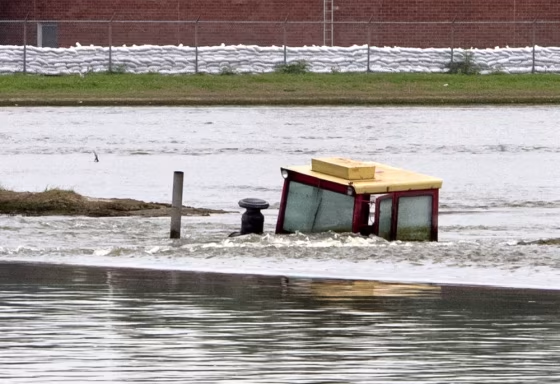
Torrential rains in the Mississippi River town of Dubuque, Iowa, earlier this week will cause the river to go above flood stage as the water moves south, a federal official said on Friday.
"The crest is working its way down the river," said Ron Fournier, a spokesman for the U.S. Army Corps of Engineers at Rock Island, Ill.
"The communities down the river are looking at an increase in river levels down to Davenport, Iowa."
Fournier said he expects the river to crest in the Davenport area at 16.2 feet by Sunday, up from about 11 feet before Wednesday's rains. He said this would bring "moderate flooding" -- possibly causing water in some streets and parks -- before it started dissipating.
Storms Wednesday night dumped a record amount of rain on parts of the Midwest, including more than 10.2 inches on Dubuque, causing evacuations and at least one death.
Meanwhile, on the swollen Missouri River, federal officials announced Friday that they were planning to gradually reduce the amount of water released from dams, easing flooding in the Missouri River valley.
In East Dubuque, Illinois, across the Mississippi River from Dubuque, Mayor George Young said about 300 people who were evacuated by bus because of Wednesday night flooding can now return to their homes.







 FOR SUBSCRIBERSA harrowing ordeal aboard an Israel-bound plane







FOR SUBSCRIBERSThe debate over AI’s future rages on both coasts

The storm washed several cars into a drainage ditch, and heavily damaged local streets. Some roads, including Route 35 to Wisconsin, remained out Friday. Young expected damage was in the millions of dollars.
"I've been here 50 years -- I've never seen it that bad," said Young. "We had people wading in neck-high water."
He said a man in nearby Galena, Ill., drowned after water swept away his car. Officials are also investigating a possible electrocution death related to the flood.
FOR SUBSCRIBERSA harrowing ordeal aboard an Israel-bound plane
FOR SUBSCRIBERSThe debate over AI’s future rages on both coasts
High water continues to impact the Chicago area. An overnight storm contributed to a total of 11.16 inches of rain for the month -- making this the wettest July since records were first kept in 1871, according to the National Weather Service.
A water taxi service that carries commuters along the Chicago River downtown had to cut back operations Friday morning because of high water, according to Andrew Sargis, manager of The Chicago Water Taxi. All taxi boats and the architecture tour boats were running as normal as of 11 a.m.
"We really haven't had these problems in the past few years, but this has been an extremely wet July, with precipitation falling very fast and overnight," said Sargis.
On the Missouri River, the Army Corps has been releasing water from six dams to deal with high snow melt and heavy rains. The flooding along the Missouri River Valley have resulted in evacuations, road closures, the prolonged shutdown of a Nebraska nuclear plant, and the need to shore up levees from Montana through Missouri.
The Army Corps announced Friday that it would start reducing the water releases from the dams, allowing the river to return to its normal banks. For example, the amount of water released from the Gavins Point Dam at Yankton, South Dakota, will gradually be reduced to 40,000 cubic square feet per second by October 1, down from a high of 160,000 square feet per second, according to the Army Corps.
"We need to get people back in their homes, farms and businesses," said Army Corps Brigadier General John McMahon.
He said the Corps also needs to repair flood controls to prepare for 2012. The Missouri River flooding this year was equivalent to a "one in 500-year event," with a low probability of reoccurring in 2012, he said.
The river could fall below flood stage at Omaha, Neb., by mid-September, depending on weather conditions, the Corps said.