
The Cassini spacecraft has returned a detailed new picture of Saturn as the craft makes its final approach toward the ringed planet. The image is the first of many that should now begin to flow from the mission.
"Prepare to be amazed," said Carolyn Porco, Cassini imaging team leader at the Space Science Institute in Boulder, Colo.
In the new photograph, Saturn is 60 percent larger than it was in the last Cassini image, made in December. Details are visible in the planet's rings and clouds. And already scientists have found a puzzle.
There is a "noticeable absence" of ghostly, spokelike dark markings in the rings. The features were discovered during the approach of the Voyager probe 23 years ago.
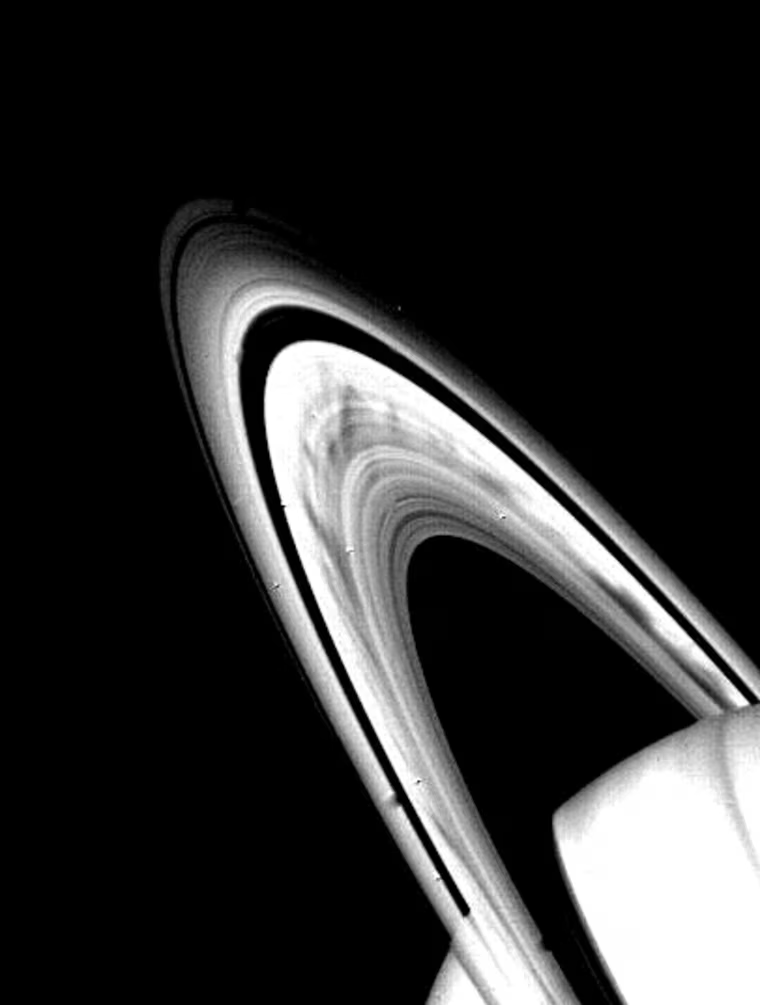
Porco said this new puzzle is one of many in store for the mission.
The origin of the rings is itself a mystery.

 FOR SUBSCRIBERSCBP leaders cut out of Trump ad buy decision









FOR SUBSCRIBERSA harrowing ordeal aboard an Israel-bound plane





FOR SUBSCRIBERSCBP leaders cut out of Trump ad buy decision
FOR SUBSCRIBERSA harrowing ordeal aboard an Israel-bound plane
Porco said images will now be released weekly, then more frequently starting in late May.
The spacecraft will enter orbit around Saturn on July 1. The mission will explore the planet's atmosphere and its rings and moons. Scientists expect to find previously unknown moons embedded in the rings, which contain icy particles from dust-grain size up to rocks and boulders.
On May 18, Cassini will enter the Saturn system, passing a group of outer moons as the gravitational pull of the giant planet begins to overpower that of the sun. Observations of Saturn's largest moon, Titan, will begin a few days later.
On June 11, Cassini will photograph the moon Phoebe during a flyby. Phoebe is 137 miles (220 kilometers) wide, the largest of Saturn's outer moons and probably a captured asteroid.
Cassini launched in 1997. To save fuel and money, it made several planetary flybys to get speed boosts by stealing a little orbital energy from the planets. It looped around Venus twice, then flew past Earth. Later it studied and photographed Jupiter while getting a final push toward Saturn.
The spacecraft will release its piggybacked Huygens probe about six months after arriving at Saturn. Huygens will descend through the thick atmosphere of Titan on Jan. 14, 2005.
Can you spot the moon?
The new image was taken Feb. 9 and released Friday. Cassini was 43.1 million miles (69.4 million kilometers) from Saturn. The image contrast and colors have been slightly enhanced to improve visibility.
The icy moon Enceladus is faintly visible to the left, outside the rings. Enceladus is about 323 miles (520 kilometers) wide. Its brightness has been increased seven times relative to the planet, in order to make it noticeable. Cassini will investigate the moon more closely later in the mission.
Cassini has traveled 2.1 billion miles (3.4 billion kilometers) on its looping path. The mission is a cooperative effort of NASA, the European Space Agency and the Italian Space Agency.