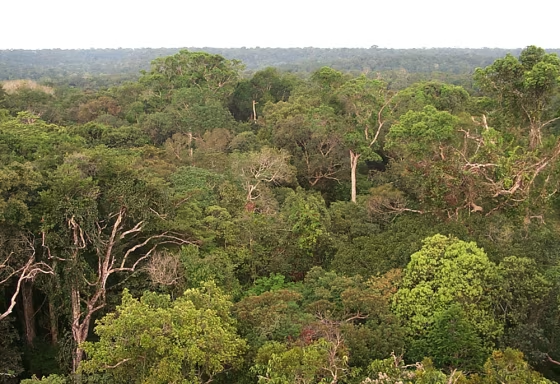
Strange things are happening in the Amazonian rainforests and scientists said Wednesday rising levels of carbon dioxide could be the cause.
Even in pristine rainforests unaffected by human activities such as logging or burning, researchers have noticed dramatic differences in the growth patterns of trees over the past 20 years.
That could distort the forest’s fragile balance, affecting rare plant and animal species.
“The changes in Amazonian forests really jump out at you,” said William Laurance of the Smithsonian Tropical Research Institute in Panama. “It’s a little scary to realize seemingly pristine forests can change so quickly and dramatically.”
Laurance and his team, whose research was published in the journal Nature, noticed that the growth of large trees in the Amazonian rainforests have accelerated over the past two decades while the growth of smaller ones has slowed.
Levels of carbon dioxide have risen by 30 percent in the past 200 years because of emissions from automobiles and industry and forest burning, particularly in the tropics.
















Much of the increase in carbon dioxide, which plants use from the air for photosynthesis, has occurred since 1960.
The scientists suspect the rising carbon dioxide levels are fertilizing the rainforests and increasing competition for light, water and nutrients in the soil. So the big fast-growing trees have an advantage and are outpacing the smaller ones.
The researchers believe the odd change in growth patterns could be a signal for an overall change in rainforest ecology.