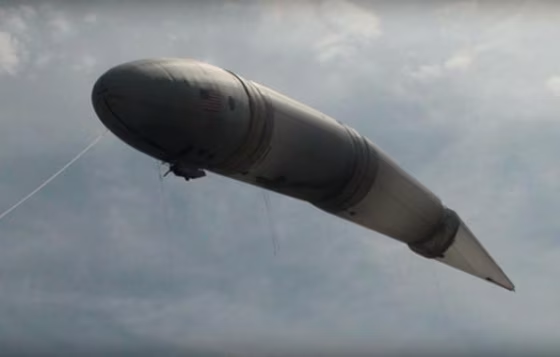
Drones and satellites dominate the U.S. military's surveillance arsenal, but fleets of unmanned airships could soon join in keeping an eye on battlefields. One robotic airship contender, the modular Argus One, has upcoming flight demonstrations scheduled at a U.S. Department of Energy Nevada Test Site that hosted nuclear bomb tests during the Cold War.
The Argus One's design resembles a segmented sky worm made of connecting modules, and has the flexibility to quickly change its flight path as it slinks through the sky. It can also carry 30 pounds of surveillance sensors or cameras — true to its name taken from an all-seeing Greek god with 100 eyes. U.S. Department of Defense observers plan to watch it in action during the scheduled December flight tests.
Having a flexible body structure means the Argus One can deploy from even the most remote, mountainous regions of Afghanistan without the need for hangars or airport infrastructure, and can fly for several days straight even in rough weather. Its flight control comes from air-filled bags within each separate module.







 FOR SUBSCRIBERSA harrowing ordeal aboard an Israel-bound plane







FOR SUBSCRIBERSThe debate over AI’s future rages on both coasts

Such ruggedness and a promise of lower costs may give manned airships or robotic aircraft a run for their money, according to its description by developer World Surveillance Group Inc. The Argus One can even maintain a fairly stealthy profile in hostile territory, because its payload represents the only radar-reflecting part of its flexible body.
FOR SUBSCRIBERSA harrowing ordeal aboard an Israel-bound plane
FOR SUBSCRIBERSThe debate over AI’s future rages on both coasts
Once the Nevada flight tests wrap up, World Surveillance Group and its partner, Eastcor Engineering, plan to prepare a performance data package being developed by Space Florida.
Follow InnovationNewsDaily on Twitter @ News_Innovation, or on Facebook.