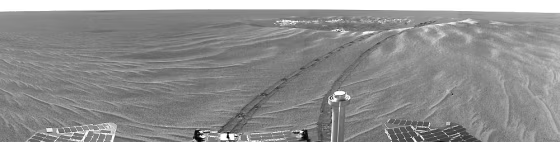
NASA’s Opportunity rover on Monday managed to climb up and out of the Martian crater that it explored for nearly two months, overcoming a slippery slope that left the vehicle spinning its wheels during an earlier attempt.
The short drive across the sandy inner rim of Eagle Crater placed the rover outside the shallow depression for the first time since it landed Jan. 24.
“The good news is we successfully charged up the rim,” mission manager Matt Wallace said. Once out, the rover rolled about 16½ feet (5 meters) before coming to a stop.
An initial attempt to get out of the crater ended in failure on Sunday. The six-wheel-drive rover could not gain traction while trying to climb straight up the 16-degree slope of the 10-foot-deep (3-meter-deep) depression.
So on Monday, NASA’s Jet Propulsion Laboratory sent Opportunity on a diagonal course across the inner rim. That gentler approach worked.
“There was a little bit of nervousness, just because of the unexpected slippage we saw yesterday,” Wallace said, adding that the incident made it clear engineers still did not completely understand how the Martian soil affects the rover’s ability to move.







 FOR SUBSCRIBERSA harrowing ordeal aboard an Israel-bound plane







FOR SUBSCRIBERSThe debate over AI’s future rages on both coasts

Halfway around Mars, Opportunity’s twin, Spirit, has been exploring the rim of a far larger crater before it strikes out for a distant cluster of hills. It landed Jan. 3.
FOR SUBSCRIBERSA harrowing ordeal aboard an Israel-bound plane
FOR SUBSCRIBERSThe debate over AI’s future rages on both coasts
Opportunity’s next targets include a rock nicknamed Scoop and a patch of bright soil. Scientists then want to send the vehicle on a 2,600-foot drive to another, larger crater.
NASA launched the twin, $820 million mission to search Mars for evidence the planet once was a wetter place. Opportunity already has uncovered such evidence.