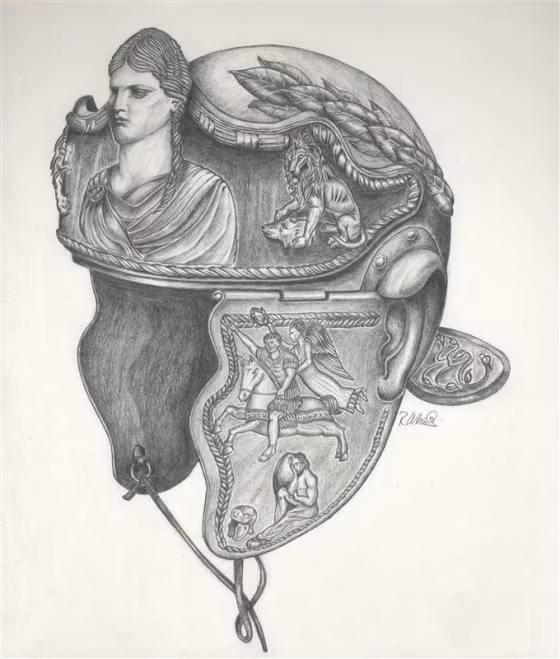
A rare Roman cavalry helmet dating from Emperor Claudius' invasion of Britain nearly 2,000 years ago was unveiled on Tuesday after painstaking restoration lasting nearly a decade.
The so-called Hallaton Helmet was found 10 years ago during the excavation of an Iron Age shrine at Hallaton in Leicestershire, central England.
At the time, archaeologists used to finding more instantly recognizable gold and silver coins joked that they had unearthed a fairly modern "rusty bucket."
In fact what they had found was a treasure of considerable importance which experts said pointed to the close relationship between Roman invaders and some native Britons.
"The helmet doesn't seem to be damaged, so it could have been taken in battle but I think that's not terribly likely," Peter Liddle, community archaeologist for Leicestershire County Council, told Reuters.
"I think two things are the most likely — this belonged to a Briton who has fought in the Roman Army and got back home in one piece or it was a diplomatic gift from the Romans to a local ruler to cement an alliance," he added.
The the helmet was estimated to be worth 300,000 U.K. pounds (more than $460,000).
The paper said wearer of the helmet would have "shone in the sun like a god."
It said the helmet was discovered by Ken Wallace, a retired teacher and a member of a local archaeology group, in 2001.
The first thing he saw was a human ear made of silver sticking out of the mud, and he then used his metal detector to find a number of coins, The Guardian said. At that point, he decided to call in the experts.
Wallace told the paper that the treasure that was eventually unearthed, including more than 5,000 pieces of Roman and British gold and silver, was "jaw-dropping."
Alongside the valuables, three skeletons of dogs about the size of Labradors were found "on guard for eternity," The Guardian said.
Major religious center
Both possibilities challenge the idea that it was Romans versus Britons in and around 43 AD when Emperor Claudius' conquest began.

 FOR SUBSCRIBERSCBP leaders cut out of Trump ad buy decision









FOR SUBSCRIBERSA harrowing ordeal aboard an Israel-bound plane





The site where the helmet was found is believed to be a major religious center which has produced one of the largest number of Iron Age coins ever discovered in Britain.
FOR SUBSCRIBERSCBP leaders cut out of Trump ad buy decision
FOR SUBSCRIBERSA harrowing ordeal aboard an Israel-bound plane
The presence of pig bones also points to ritual feasting dating to the mid-1st century AD.
The remains of the once magnificent helmet had to be lifted from the site in a soil block and transported to the British Museum where experts spent years piecing together hundreds of fragments in a process likened to a 3D jigsaw puzzle.
Marilyn Hockey, head of ceramics, glass and metals conservation at the British Museum in London, said the project was one of the most challenging of her career.
"It's wonderful to be able to coax something like this out of the soil and to allow it to show itself off again," she said.
What Hockey discovered was a helmet built of sheet iron, once covered with carefully crafted silver sheet decorated in places with gold leaf.
The helmet's bowl features a wreath, symbol of military victory, and the scallop-shaped browguard shows the bust of a woman flanked by lions and other animals.
The cheekpieces depict a Roman emperor on horseback with the goddess Victory flying behind. Beneath his horse's hooves is a cowering figure, possibly a native Briton.
It is the only Roman helmet found in Britain with the majority of the silver-gilt plating surviving, and one of only a handful ever discovered.
The Hallaton Helmet will be displayed permanently at Harborough Museum in Market Harborough, Leicestershire, from January 28 alongside the other finds from the Hallaton Treasure.