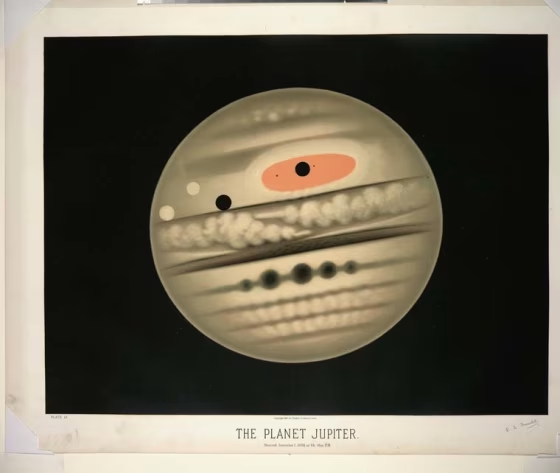
Recently digitized drawings by a 19th-century artist reveal stunning sunspots, auroras and even planetary bodies as they were observed in the Victorian era.
Recently digitized and made available by the New York Public Library, the images are a remarkably modern-looking glimpse into astronomy in the late 1800s. Drawn by French-born artist Etienne Leopold Trouvelot (1827-1895), the illustrations range from detailed surface studies of the moon to likenesses of the planets that could pass for pop art.
One drawing reveals the Great Comet of 1881 as seen in June of that year. Thanks to advances in photography, that comet was the first photographed clearly with both head and tail, according to a 1999 article in the Irish Astronomical Journal. Another details a meteor shower that lit up the skies one night in November 1868.

 FOR SUBSCRIBERSCBP leaders cut out of Trump ad buy decision









FOR SUBSCRIBERSA harrowing ordeal aboard an Israel-bound plane





Trouvelot himself is less well-known for his astronomical art as he is for his earlier hobby as an amateur entomologist. In an attempt to improve silk production in the United States, Trouvelot imported the gypsy moths from Europe. Some larvae escaped, resulting in an invasive species disaster. Today, gypsy moths are still a devastating pest, consuming forest foliage in the northeastern United States and parts of the Southeast and Midwest.
FOR SUBSCRIBERSCBP leaders cut out of Trump ad buy decision
FOR SUBSCRIBERSA harrowing ordeal aboard an Israel-bound plane
Trouvelot tried to warn entomologists about the gypsy moth introduction, according to the U.S. Forest Service, but nothing was done. He then moved on to astronomical illustration and an eventual faculty post at Harvard University. A crater on Mars bears his name.
You can follow LiveScience senior writer Stephanie Pappas on Twitter. Follow LiveScience for the latest in science news and discoveries on Twitter @livescience and on .