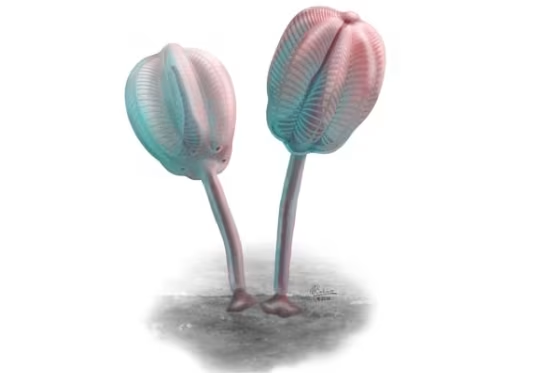
A weird tulip-shaped creature discovered fossilized in 500 million-year-old rocks had a feeding system like no other known animal, researchers reported Wednesday.
The animal was a filter feeder, with a tulip-shaped body and a stem that anchored it to the seafloor. Named Siphusauctum gregarium, the creature was about the length of a dinner knife (8 inches, or 20 centimeters) and had a bulbous structure that contained its feeding system and gut.
The fossil was discovered in a rock layer called the Burgess Shale in the Canadian Rockies.

 FOR SUBSCRIBERSCBP leaders cut out of Trump ad buy decision









FOR SUBSCRIBERSA harrowing ordeal aboard an Israel-bound plane





"Most interesting is that this feeding system appears to be unique among animals," study researcher Lorna O'Brien, a doctoral candidate at the University of Toronto, said in a statement. "Recent advances have linked many bizarre Burgess Shale animals as primitive members of many animal groups that are found today, but Siphusauctum defies this trend. We do not know where it fits in relation to other organisms."
Siphusauctum lived in gardenlike clusters on the seafloor, with some fossil slabs containing the remains of more than 65 individuals. Researchers have discovered more than 1,100 individual specimens, earning the fossil area the nickname "the tulip beds."
FOR SUBSCRIBERSCBP leaders cut out of Trump ad buy decision
FOR SUBSCRIBERSA harrowing ordeal aboard an Israel-bound plane
The findings from O'Brien and her supervisor at the Royal Ontario Museum, Jean-Bernard Caron, were published online Wednesday by the journal PLoS ONE.
You can follow LiveScience senior writer Stephanie Pappas on Twitter . Follow LiveScience for the latest in science news and discoveries on Twitter @livescience and on .