A U.S. astronaut who will be aboard next month’s flight to the international space station dismissed Russia’s financial worries Wednesday and said it was Moscow’s turn to pay for space station missions.
Russia, which will launch the crew on its next mission in April, says it wants to extend future expeditions to a year from six months to save money.
It has struggled with the financial burden of being the sole lifeline to the station for more than a year since the United States withdrew its shuttles.
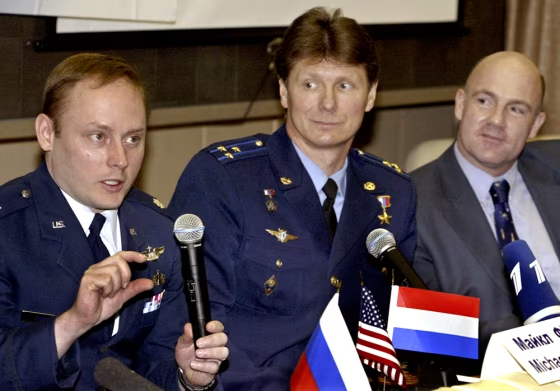
“In the United States we single-handedly paid for trips to the space station for the shuttle for many years,” said astronaut Michael Fincke, flight engineer for the April 19 mission. “We’ve flown more cosmonauts by far than the Russians have (flown) astronauts.
“We’re working together as partners and we did our share and now ... the Russian partners have come in.”
Controversial proposal
The United States grounded its shuttles in February 2003 after the shuttle Columbia disintegrated on re-entry, killing the seven astronauts on board.
Russia needs NASA’s approval to proceed with plans to extend the length of missions, but the United States has said nothing about the proposal.
Fincke was frosty toward the plan.
“We’re still trying to understand the details — I just know there’s a big difference in flying for six months and flying for a year,” he said. “A year is a long time on the human organism and also a long time away from one’s family.”







 FOR SUBSCRIBERSA harrowing ordeal aboard an Israel-bound plane







FOR SUBSCRIBERSThe debate over AI’s future rages on both coasts

FOR SUBSCRIBERSA harrowing ordeal aboard an Israel-bound plane
FOR SUBSCRIBERSThe debate over AI’s future rages on both coasts
Russia’s space agency said Tuesday the extended period would do no damage to astronauts’ health.
Passenger service
To supplement its budget, Russia has launched two fare-paying passengers into orbit. For a published price of $20 million, trained amateurs spend eight days aboard the space station. New Jersey inventor/businessman Gregory Olsen will be the third self-supported space passenger, due to lift off next year.
Fincke welcomed the idea of taking on passengers but said they should be given a clear idea of the dangers.
“The fact that everyday people, not just professionals, can have the chance to enjoy the glories of the cosmos — that’s generally a good idea,” he said, but added: “The space station right now is not like a hotel where things are quite easy for a tourist. ... Space is quite a dangerous place.”
Fincke and Russian Gennady Padalka are due to spend about six months in orbit after blasting off from the Baikonur cosmodrome in Kazakhstan.
Dutch European Space Agency astronaut Andre Kuipers will go with them to conduct experiments. He returns after 11 days with American Michael Foale and Russian Alexander Kaleri, who have manned the station since October.