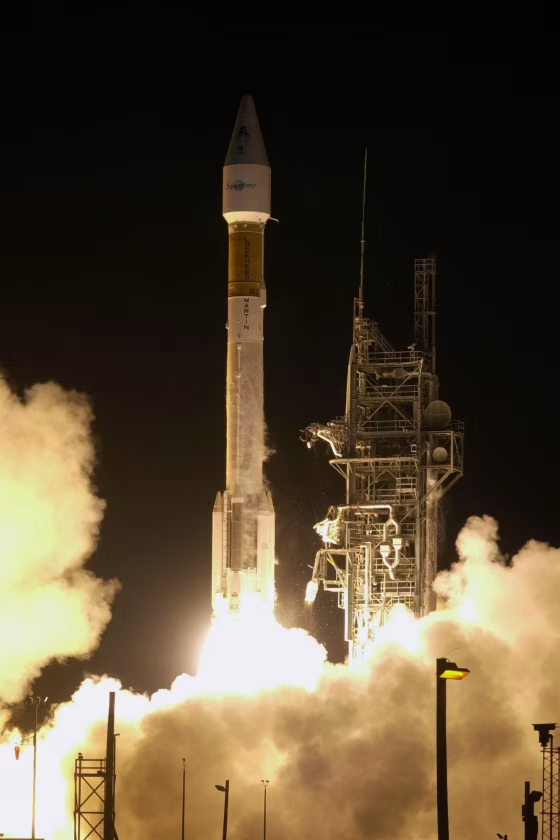
An Atlas 2 rocket carrying a Japanese communications satellite made a picture-perfect nighttime launch from Cape Canaveral on Thursday, lighting the Atlantic seaboard in central Florida like a shimmering torch.
The 8:45 p.m. ET liftoff followed a perfect countdown and extended the string of successful launches by Lockheed Martin’s Atlas to 71, dating back to 1993.
This was the fourth launch of the year for International Launch Services, a partnership between Lockheed Martin and the Khrunichev State Research Center in Russia, according to International Launch Services.
The 3.5-ton Superbird 6 satellite separated from the Atlas upper stage about 30 minutes after liftoff. It will be operated by Space Communications Corp. of Tokyo and provide home and business video and data services to Japan, Australia, New Zealand, Taiwan, Korea and Hawaii.
The satellite was built by Boeing Satellite Systems, a subsidiary of Boeing Co.
Boeing Satellite President Dave Ryan told Reuters that while commercial satellite customers make up a shrinking share of the company’s business, following a glut of launches in the late 1990s, the U.S. government is more than making up for that drop-off.
















Ryan said satellites serving the U.S. armed forces and intelligence agencies will grow from $7 billion in business in 2003 to about $17 billion a year in the next decade.
“As we’ve seen in the Middle East and Afghanistan, when you need communications quickly, you also need a lot of it,” said Ryan. The government is reaching the point where every military radio will be able capable of contact with every other military radio on the planet, not only for audio communications but also for data and streaming video, he said.
“What we expect is about two-thirds government, one-third commercial for the next few years,” Ryan said.