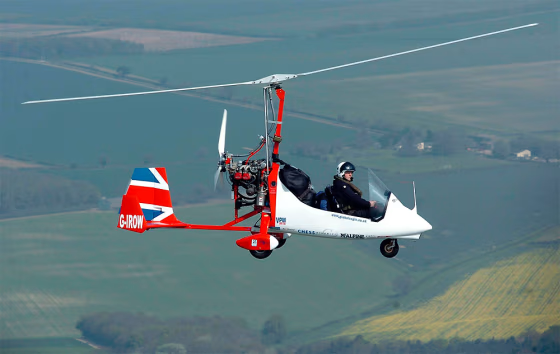
A British Army pilot set off Monday to break one of the world’s last remaining aviation records — circumnavigating the globe in an autogyro, the neglected cousin of the modern helicopter.
Flanked by the army’s Blue Eagles helicopter display team, Barry Jones took off from Middle Wallop in southern England for the first leg of a grueling, 24,700-mile (39,520-kilometer) journey that could take up to four months.
“He’ll be flying through the heat of the desert; the dense jungle of Thailand and Myanmar; over the wetlands of China and Russia; the ice of the Arctic,” team engineer Andy Wilson told Reuters.
“He’s in an open cockpit, so this will be a real test, both for him and the aircraft,” he added. “He’ll experience temperatures from 50 degrees Celsius to minus 50 (122 degrees Fahrenheit to 58 below zero). ”
The most dangerous legs are those where landing is not an option — particularly over jungle canopies and the northern Atlantic Ocean.
Invented in 1920s
The autogyro was invented in Spain in the 1920s, using an unpowered rotor to replace the wing of a conventional aircraft. They are neither fast nor economical, and have never been a commercial success.
But they are highly stable, said Wilson, and capable of gliding safely to the ground if the rear-mounted propeller fails.







 FOR SUBSCRIBERSA harrowing ordeal aboard an Israel-bound plane







FOR SUBSCRIBERSThe debate over AI’s future rages on both coasts
Autogyros briefly soared to fame in the 1967 James Bond film “You Only Live Twice,” when an autogyro known as “Little Nellie” starred alongside Sean Connery in an aeronautical dogfight.
FOR SUBSCRIBERSA harrowing ordeal aboard an Israel-bound plane
FOR SUBSCRIBERSThe debate over AI’s future rages on both coasts
They have also been used in military reconnaissance and in the search for Scotland’s legendary Loch Ness monster.
'Besotted' with autogyros
Jones, a 37-year-old Lynx pilot, first saw an autogyro while flying for the army over Scotland.
“He became besotted with them,” said project manager Peter Taylor, who along with Jones remortgaged his house to finance the expedition when it failed to find a backer.
“We were sat in a bar in Yorkshire and he said, ‘I wonder if anyone has flown one of those things round the world?’ Eighteen months later and he’s on his way.”