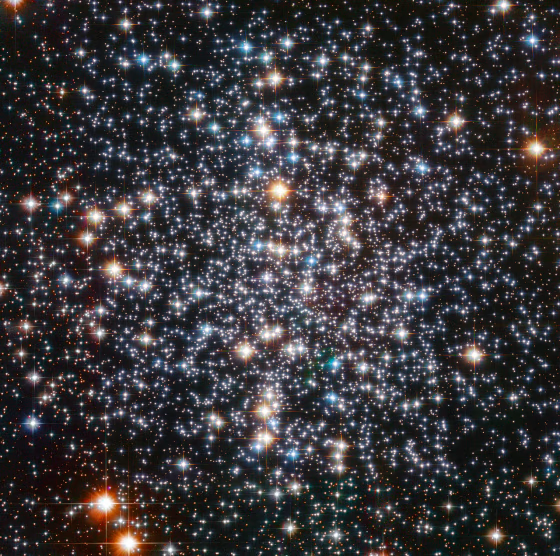
Countless stars at the core of a nearby star cluster look like glowing, multicolored orbs in a stunning new photo snapped by the Hubble Space Telescope.
The image shows the heart of a globular cluster called M4, which is found about 7,200 light-years from Earth — close enough to make it a prime target for astronomers to study.
M4 contains tens of thousands of stars, researchers said. The cluster hosts many white dwarfs, the leftover cores of old and dying stars whose outer layers have been shed into space.
Hubble has a history with M4. In July 2003, the telescope's observations helped scientists discover an alien planet called PSR B1620-26 b in the cluster. The planet, which is about 2.5 times as massive as Jupiter, is thought to be about 13 billion years old. For comparison, our own solar system is just 4.5 billion years old.
PSR B1620-26 b is also unusual in that it orbits a binary system consisting of a white dwarf and a pulsar, researchers said. A pulsar is a type of neutron star, which is the incredibly dense remnant of a dead "normal" star that has been squeezed down into a city-size object.
Pulsars emit beams of light pointing from their poles that appear to pulse on and off as they sweep toward and away from Earth — hence the name.

 FOR SUBSCRIBERSCBP leaders cut out of Trump ad buy decision









FOR SUBSCRIBERSA harrowing ordeal aboard an Israel-bound plane





M4 is visible to skywatchers with binoculars or a small telescope, NASA officials said. Scan the skies near the red-orange star Antares, in the constellation Scorpius, and you should find it. But don't expect Hubble-level clarity and detail; M4 will appear as a fuzzy ball of light in your eyepiece.
FOR SUBSCRIBERSCBP leaders cut out of Trump ad buy decision
FOR SUBSCRIBERSA harrowing ordeal aboard an Israel-bound plane
The Hubble Space Telescope is a joint operation of NASA and the European Space Agency and launched in April 1990. It has made more than 1 million science observations since, and it's still going strong.
Follow Space.com for the latest in space science and exploration news on Twitter and on .