New 3-D videos showing how plant roots navigate their environment could help to improve crop growth in areas with difficult soil conditions.
The research, outlined in the latest Proceedings of the National Academy of Sciences, reveals how certain plant roots exhibit powerful mechanical abilities.
PHOTOS: D.C. Cherry Trees Turn 100
For the study, scientists from Cornell University and the Boyce Thompson Institute for Plant Research grew barrel clover (Medicago truncatula) plants. This plant is a small legume from the Mediterranean often used in research projects. The scientists grew the plants in a transparent gel with two layers — a soft top layer and a stiff lower layer. These layers mimic the different conditions plants face in various substrates.
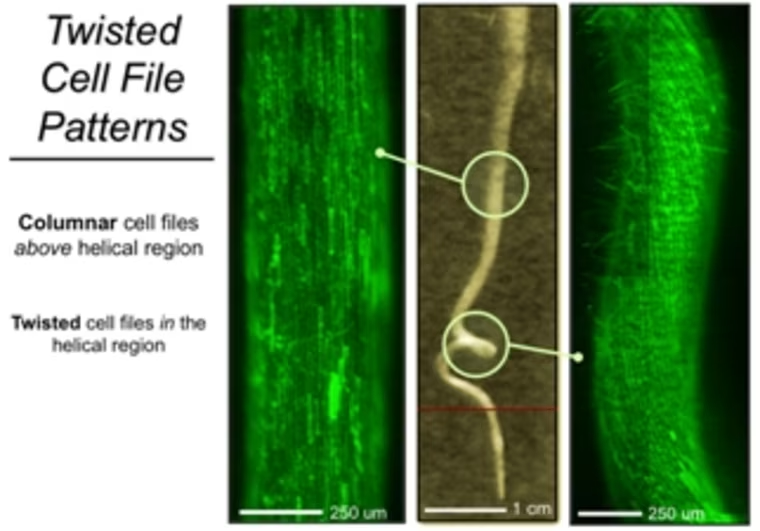
An advanced 3-D time-lapse video system recorded that the roots grew straight down until they reached the lower layer. There, they began to twist and buckle into spring-like shapes, similar to the way that a string begins to curl if it's continuously twisted in one direction.
ANALYSIS: Clear Soil Could Improve Crops
"When the roots hit the stiff barrier, growth causes them to buckle like a wire or rod that's been compressed. But by twisting, the buckled roots become helical, allowing the root to push off more gel and get more force at the tip," Jesse Silverberg, a Cornell graduate student in the Department of Physics and lead researcher for the study, was quoted as saying in a press release.

 FOR SUBSCRIBERSCBP leaders cut out of Trump ad buy decision









FOR SUBSCRIBERSA harrowing ordeal aboard an Israel-bound plane





FOR SUBSCRIBERSCBP leaders cut out of Trump ad buy decision
FOR SUBSCRIBERSA harrowing ordeal aboard an Israel-bound plane
"Suppose the plant is growing along and finds itself stuck at a layer of clay or tough clump of soil," Silverberg continued. "The root needs an extra force to push through these barriers, and the mathematical model tells us how large of a helix the root needs to grow to do just that. Roughly, the stiffer the barrier, the larger the helix."
ANALYSIS: Sinking Tomatoes! Where Did the Farm Go?
Mechanics plays an important role in determining root shapes. This study uncovered a previously unknown connection between root geometry, growth and force generation. In this particular case, 74 percent of the plant roots twisted in a counter-clockwise manner.