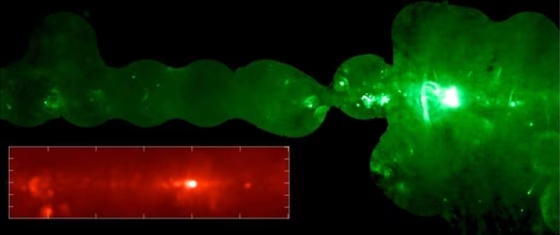
New observations of the center of our Milky Way Galaxy have revealed the origin of radio-emitting filaments that puzzled astronomers for two decades.
The filaments range from 10 to 100 light-years in length and 1 to 3 light-years across. They occur only in a very narrow area, within about 900 light-years of the galactic center, a region crowded with old and new stars.
A light-year is the distance light travels in a year, about 6 trillion miles (10 trillion kilometers). The Milky Way in its entirety spans more than 100,000 light-years.
The filaments emerge from pockets of intense star formation, the new study found.
"We can finally see a link between areas of starburst activity and these long-linear filaments," said Farhad Yusef-Zadeh, a Northwestern University astronomer who presented the results last week at a meeting of the American Astronomical Society in Denver.
Black hole's surroundings
The center of the Milky Way is dominated by a supermassive black hole, which is surrounded by an intense magnetic field and pockets of rampant star formation.
Scientists had theorized that the filaments were related to the magnetic field, because the first filaments spotted were aligned with it.







 FOR SUBSCRIBERSA harrowing ordeal aboard an Israel-bound plane







FOR SUBSCRIBERSThe debate over AI’s future rages on both coasts

"The problem with this hypothesis is that more recent images have revealed a population of weaker filaments oriented randomly," Yusef-Zadeh said. "This makes it difficult to explain the origin of the filaments by an organized galactic magnetic field."
FOR SUBSCRIBERSA harrowing ordeal aboard an Israel-bound plane
FOR SUBSCRIBERSThe debate over AI’s future rages on both coasts
Radio observations made
The center of the galaxy is shrouded by dense clouds of dust and gas, making optical observations impossible. So Yusef-Zadeh's team probed the area with radio observatories, the National Science Foundation's Very Large Array and Robert C. Byrd Green Bank Telescope.
The researchers found that some filaments seemed to connect to concentrated areas of thermal emission, which in turn identify pockets of star formation. The star-forming regions associated with the filaments may contain 100 massive stars each.
The exact mechanism that creates the filaments remains to be discovered.
"One possibility is that they are produced by the collision of winds blown off from individual stars," Yusef-Zadeh said.