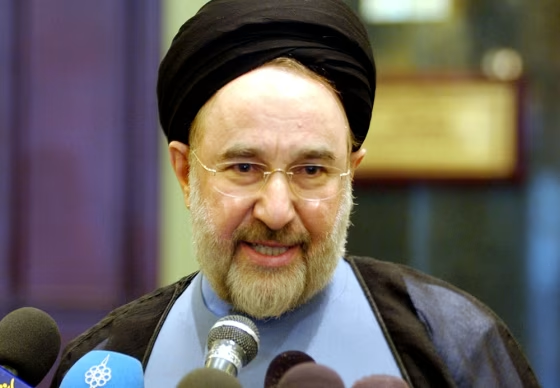
Iran will not accept a draft proposed by three European nations criticizing its nuclear activities if the U.N. nuclear watchdog agency approves it, Iranian President Mohammad Khatami said Wednesday.
Khatami also told reporters after a Cabinet meeting that Iran has no "moral" commitment to suspend nuclear enrichment if the current trend at the International Atomic Energy Agency continues.
He stopped short of saying Iran will resume the enrichment process, or will stop all cooperation with the IAEA.
"If the draft resolution proposed by the European countries is approved by the IAEA, Iran will reject it," Khatami said. "If Europe has no commitment toward Iran, then Iran will not have a commitment toward Europe. We assume they are not respecting their commitments."
Under growing international pressure, Iran suspended uranium enrichment last year and stopped building centrifuges. It also agreed to accept a protocol permitting intrusive inspections of its facilities without notice. In return, Germany, Britain and France agreed to make it easy for Iran to obtain advanced nuclear technology for peaceful purposes.
On Tuesday, diplomats at the IAEA neared agreement on a harsh rebuke of Iran for blocking a U.N. probe of its suspect nuclear activities, despite lobbying by Tehran to tone down the reprimand.
Delegates representing some of the 35 nations at the IAEA board of governors' meeting said that the newest draft, written by Germany, France and Britain, would likely be formally accepted soon.
Even though the draft does not directly threaten sanctions, its tough wording amounts to substantial pressure on Iran to clear up aspects of what was a covert nuclear program for nearly 20 years until discovered two years ago.

 FOR SUBSCRIBERSCBP leaders cut out of Trump ad buy decision









FOR SUBSCRIBERSA harrowing ordeal aboard an Israel-bound plane





FOR SUBSCRIBERSCBP leaders cut out of Trump ad buy decision
FOR SUBSCRIBERSA harrowing ordeal aboard an Israel-bound plane
In Vienna, Kenneth Brill, the chief U.S. delegate to the IAEA, said Washington remained convinced that Iran was "trying to hide ... a weapons program."
Iran repeatedly has denied this. Iran, which also denies working on enrichment beyond the experimental stage, says minute finds of enriched uranium -- which include traces at weapons-grade levels -- within the country were not domestically produced but inadvertently imported in purchases through the nuclear black market.
Another main agency concern is ambiguous, missing or withheld information on the scope of Iran's centrifuge program, used to enrich uranium.
An IAEA report, written by the agency's chief Mohamed ElBaradei, says Iran inquired about buying thousands of magnets for centrifuges on the black market -- casting doubt on Iranian assertions that its P-2 centrifuge program was purely experimental and not aimed for full uranium enrichment.
In desperate efforts to sway the meeting, the Iranian delegation met privately with ElBaradei on Tuesday and lobbied with the chief delegates of the three European nations who wrote the draft, according to a diplomat close to the agency.