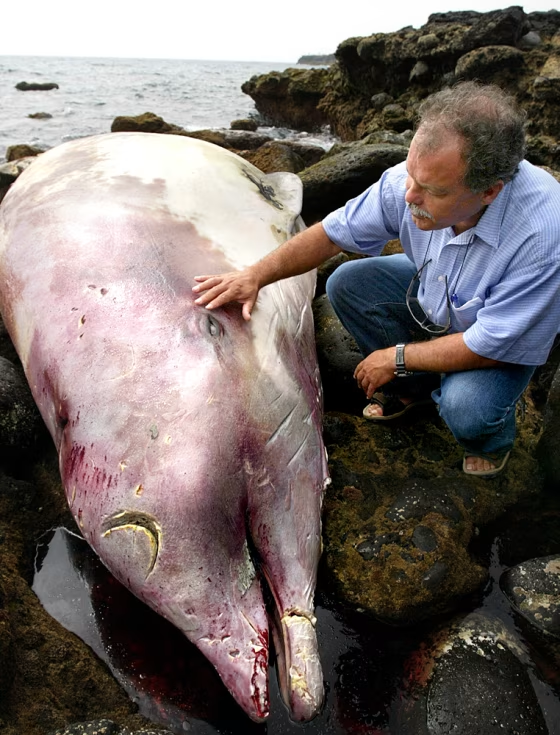
Two dead whales have landed in Spain’s Canary Islands, raising fears they may have been hurt by NATO underwater military exercises off Morocco and that more could have died, officials said Friday.
The two whales beached within 24 hours of each other and were dead for several days before their bodies drifted ashore, said Tony Gallardo, environmental expert with the local government of the island of Fuerteventura, one of the Canaries, which lies about 60 miles off the southern Moroccan coast.
“There is a strong suspicion that their deaths were related to the NATO exercises that finished a few days ago,” Gallardo told Reuters.
Naval and air force units from 10 countries involving 20,000 troops and more than 20 warships took part in U.S.-led NATO military exercises off Morocco from July 11 to 16.
NATO officials had no comment.
The Canary Islands regional government dispatched a helicopter to search the coastline after fishermen reported seeing something that looked like a third dead whale floating a few miles from the shore.
Similar deaths in 2002
Fourteen whales beached in the Canaries in 2002 during multinational military exercises there. It was one of several mass strandings of whales that scientists have linked to the use of naval sonar systems.
A year later, researchers published a study in the science journal Nature that found sonar may cause a type of decompression sickness in whales and dolphins.
Scientists suspect sonar signals disorient the mammals, forcing them to come up to the surface too quickly, which could cause the formation of damaging nitrogen bubbles in their tissue.
Military sonar systems blast areas of ocean with sound waves to detect submarines.
New report endorses view
Earlier this week, experts with the International Whaling Commission said their review of case studies indicated overwhelming evidence for sonar-caused whale deaths.
The IWC report adds weight to theories that sonar harms the giant sea mammals, a hypothesis that has been disputed by the military and by the oil and gas industry which uses the technology to search for energy reserves.

 FOR SUBSCRIBERSCBP leaders cut out of Trump ad buy decision









FOR SUBSCRIBERSA harrowing ordeal aboard an Israel-bound plane





“There is now compelling evidence implicating military sonar as a direct impact on beaked whales in particular,” said the report released at the IWC’s annual convention.
FOR SUBSCRIBERSCBP leaders cut out of Trump ad buy decision
FOR SUBSCRIBERSA harrowing ordeal aboard an Israel-bound plane
The report cited examples of bizarre and self-destructive whale behavior that seemed to have been caused by military sonar, such as a mass stampede of 200 melon-headed whales into shallow water in Hawaii last month during a U.S.-Japanese naval training exercise. One animal died.
The report may strengthen the hand of U.S. conservation groups threatening to sue the Navy over its use of mid-frequency sonar.
Mid-frequency sonar targeted
The Natural Resources Defense Council has already secured an injunction limiting the U.S. Navy’s use of new low-frequency sonar that can travel vast distances through the oceans, and is now targeting the more common mid-frequency sonar.
“This is the first time such a broad, diverse group (of scientists) has made this finding,” said council lawyer Joel Reynolds. “Navies of the world do back-flips to deny any connection.”
The IWC, a 57-country intergovernmental body which regulates whaling, said earlier in the week that oil and gas exploration off Russia’s Pacific coast threatened a colony of gray whales with extinction due to sonar and pollution.
Energy firms blast noise waves down to the sea floor to detect the presence of oil and gas reserves.
The IWC expressed concern about energy activities in the Sakhalin Island region off Russia where Royal Dutch/Shell, Exxon Mobil and BP operate.
Its scientific report also identified oil and gas exploration near the Abrolhos Banks, a coral reef off Brazil, as a hazard for humpback whales and called on the government to protect the mammals from the noise.