Scientists pondering ancient fossils stored in the nation’s attic have uncovered new evidence of a life-and-death arms race hundreds of millions of years ago.
Paleontologists Forest Gahn and Tomasz Baumiller studied fossils from the Paleozoic Era, between 570 million years ago and 245 million years ago, a time when fish were evolving into many new species with bigger teeth and more advanced hunting methods.
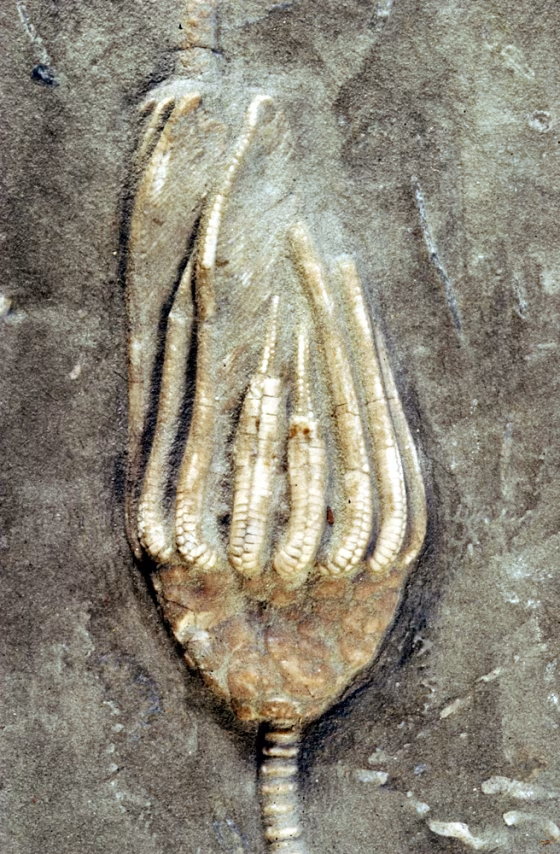
Fossils stored at the Smithsonian’s National Museum of Natural History revealed that, at that same time, crinoids — a type of sea creature with arms, related to starfish and sea urchins — began to experience a sharp increase in damage from attacks by predators.

 FOR SUBSCRIBERSCBP leaders cut out of Trump ad buy decision









FOR SUBSCRIBERSA harrowing ordeal aboard an Israel-bound plane





Crinoids can regenerate arms, and the researchers report in Friday’s issue of the journal Science that the amount of arm regeneration more than doubled, from under 5 percent to more than 10 percent, at this time.
FOR SUBSCRIBERSCBP leaders cut out of Trump ad buy decision
FOR SUBSCRIBERSA harrowing ordeal aboard an Israel-bound plane
At the same time, crinoids and their relatives also began evolving defensive measures, such as thicker shells and spines, in response to the increased attacks.
Gahn, of the Natural History Museum, and Baumiller, of the University of Michigan Museum of Paleontology, examined more than 2,500 Paleozoic crinoids for arm regeneration. Most of their data was derived from the Springer Collection at the Smithsonian.