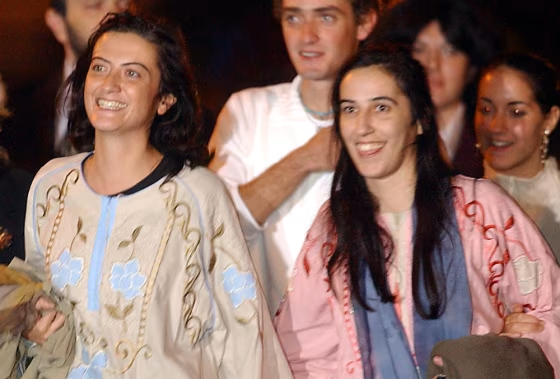
National joy in Italy at the safe return of two aid workers held hostage in Iraq gave way in some quarters on Wednesday to concern that Rome had paid a ransom for the women’s freedom.
While most Italians simply delighted that “the two Simonas” had told police they were treated “very well” during three weeks in blindfold captivity, some warned of the risks of buying off kidnappers.
Prime Minister Silvio Berlusconi’s government was still refusing to comment publicly on whether a ransom was paid to secure the release of Simona Pari and Simona Torretta, both 29.
But the chairman of parliament’s foreign affairs committee said Italy probably paid a ransom of around $1 million:
“The lives of the girls was the most important thing,” said Gustavo Selva, a member of Berlusconi’s center-right coalition.
“In principle, we shouldn’t give in to blackmail but this time we had to, although it’s a dangerous path to take because, obviously, it could encourage others to take hostages, either for political reasons or for criminal reasons.”
Asked by French radio station RTL whether the ransom had been $1 million, Selva said: “I think we paid in the end. The sum is probably correct.”







 FOR SUBSCRIBERSA harrowing ordeal aboard an Israel-bound plane






FOR SUBSCRIBERSThe debate over AI’s future rages on both coasts
The release of the Italians has raised some hopes in France for two French journalists held in Iraq for over a month.
Conservative Italian newspaper Il Folio condemned paying ransom: “They did honest humanitarian work and ended up being unwitting collection plates,” it said in an editorial headlined “Let’s Not Celebrate.”
“That is called ransom and it will fuel the arms trade and recruitment for the war against peace and democracy in that part of the world,” it said.
National joy
Few Italians paid great attention to the ransom issue and most media concentrated on the women’s welfare.
FOR SUBSCRIBERSA harrowing ordeal aboard an Israel-bound plane
FOR SUBSCRIBERSThe debate over AI’s future rages on both coasts
Freed on Tuesday and flown home as national heroines, they gave their first accounts of their ordeal to police: “We were always blindfolded and we never saw the faces of our captors,” one of them was quoted as saying by a judicial source.
A police official who questioned the women said they were treated “very well” and that they “only sometimes feared for their lives.”
The two were abducted at gunpoint from the Baghdad offices of their charity group, which helped schoolchildren, on Sept. 7 along with two Iraqi colleagues, who were also freed.
Italians had feared the women would suffer the same fate as other hostages, including Italian journalist Enzo Baldoni, who was killed last month after Italy refused to withdraw its 2,700 troops from Iraq.
Tens of millions of Italians were glued to their television sets on Tuesday night to see live broadcasts of the women’s reunion with their families at a Rome airport, where they were greeted by Berlusconi and other leaders.
Rome’s Colosseum was lit up overnight and celebrations rang out across the country. Photos of the smiling women filled pages of Italian newspapers, all of which ran oversized headlines such as “Back Home,” and “Freed.”
“It was a wonderful thing. We were all waiting for this to happen and luckily it ended with the great news that they had been released,” said pensioner Filippo Mari.
Some Italians, who have long opposed presence of their troops in Iraq, peppered their relief with words of caution.
“Something good happened — but we should all think hard as it won’t be easy to bring democracy to a country like this when this kind of thing happens,” Luca Marozzi said.