Eight Arctic countries on Wednesday agreed to encourage "effective measures" to curb a rapid melt of the region, but indigenous peoples accused the United States of having blocked mandatory action aimed at slowing global warming.
The United States, Russia, Canada and the five Nordic states, which all have areas stretching into the Arctic, encouraged “effective measures” to adapt to climate change without spelling out exactly how.
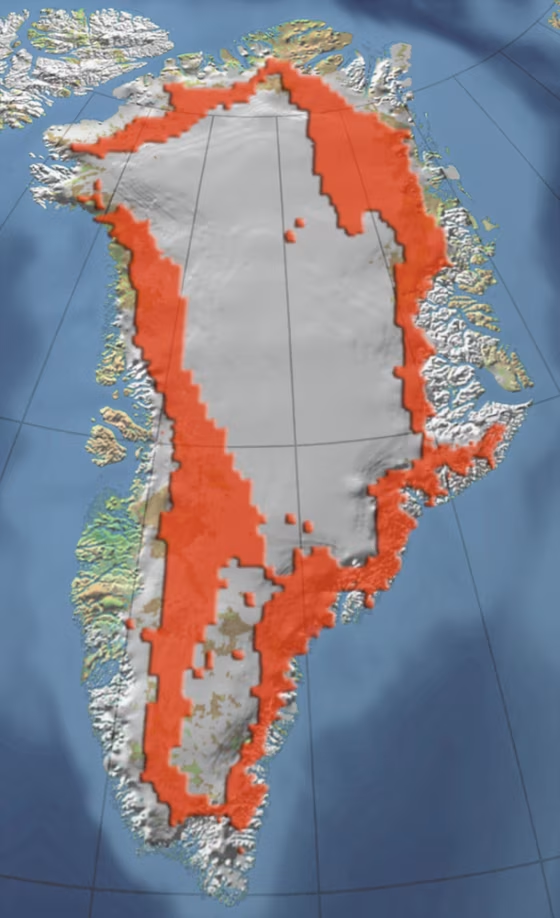
And governments noted “with concern” a report earlier this month by 250 scientists warning that the Arctic is warming twice as fast as the rest of the globe. They would take the findings into account in policies on everything from research to aiding indigenous peoples.
“We all need to intensify efforts against pollution in the Arctic,” Russian Foreign Minister Sergei Lavrov said at the one-day meeting in Iceland.
But environmentalists, indigenous peoples and some of the Arctic nations had wanted an accord urging sharp cuts in greenhouse gas emissions from cars and factories blamed for a warming that could melt the ice around the North Pole in summer by 2100.
“In terms of what the planet needs, this is far from enough,” said Sheila Watt-Cloutier, chair of the Inuit Circumpolar Conference, which says it represents 155,000 people in Canada, Alaska, Greenland and Russia.
Still, she said that a seven-page policy document was more than she had expected from the consensus-based Arctic Council.
The United States said it would not sign up for any calls for caps in emissions of heat-trapping gases like carbon dioxide. Washington is the only nation of the eight that has refused to join the 128-nation Kyoto protocol on curbing global warming.
“I don’t know why the United States is like an ostrich burying its head in the sand,” said chief Gary Harrison of the Arctic Athabaskan Council, which represents thousands of people in Canada and Alaska.
But Paula Dobriansky, U.S. undersecretary for global affairs, rebuffed the criticisms. “We base our policies on science and we will take the findings (of the report) into account,” she said.
















“We have a vibrant national program” for addressing climate change, she told Reuters, saying that the United States was spending $5.8 billion on projects ranging from promoting renewable energy to burying carbon dioxide below ground.
Delegates, who have wrangled for months over policies, laughed when Finnish Foreign Minister Erkki Tuomioja summed up by saying: “This is the best possible declaration -- that could be adopted today.”
The Arctic warms fast because dark water and ground, once exposed, soaks up more heat than ice or snow. One result of the melt could be easier access to oil and gas, minerals and timber.
“It is alarming that some governments and many multinational enterprises seem to be most impressed by the fact that a warmer Arctic may become a more accessible Arctic,” said Geir Tommy Pedersen, head of the Saami council based in north Norway.
Environmentalists, for their part, said the meeting was a lost opportunity to slow damaging climate change by the eight countries, which account for 40 percent of global greenhouse gas emissions.
The World Wildlife Fund — which set up an ice sculpture of a polar bear outside the ministers’ meeting room, dripping away into a tray in the heat — urged all governments in the region to promise deep cuts in greenhouse gases.
“Arctic governments missed the chance to show leadership on climate change,” it added.