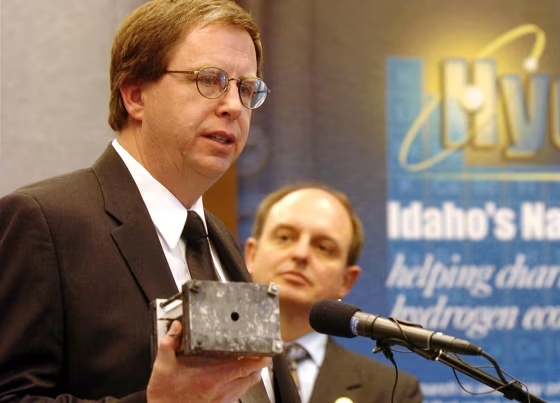
A government laboratory and a private company announced a $2.6 million project Monday to develop hydrogen in a nuclear reactor using a process with the potential to one day trim the country’s reliance on fossil fuels.
High-temperature electrolysis could become economically feasible by using the next generation of nuclear reactors to split water into hydrogen and oxygen, said officials with Ceramatec Inc. and the Idaho National Engineering and Environmental Laboratory.
“We have been able to show that we can produce hydrogen at commercially attractive rates in a very small unit and at conditions that are typical of a high-temperature, helium-cooled reactor,” said laboratory researcher Steve Herring.
The sample, about the size of a paperback book, had its successful test in a pottery kiln used to simulate the high temperatures created by the next generation of nuclear reactors — about 1,800 degrees Fahrenheit (982 degrees Celsius).
Researchers said the process of obtaining hydrogen by splitting water using electric energy has been known for about 150 years. Its high cost in dollars and electric energy made it an unpopular choice.
“High-temperature electrolysis has the potential to change that by reducing the amount of electrical energy required and using a proportion of thermal energy in its place,” said Joseph Hartvigsen of Ceramatec.







 FOR SUBSCRIBERSA harrowing ordeal aboard an Israel-bound plane







FOR SUBSCRIBERSThe debate over AI’s future rages on both coasts

The Energy Department is hoping for a demonstration of commercial-scale hydrogen production using the process by 2017.
FOR SUBSCRIBERSA harrowing ordeal aboard an Israel-bound plane
FOR SUBSCRIBERSThe debate over AI’s future rages on both coasts
Researchers admit it would be decades before hydrogen power and its infrastructure are as commonplace as refineries and gas stations. Herring said the most immediate use of hydrogen using the new process would be to upgrade poor-quality petroleum for use as motor fuel, and then synthesizing existing fuels that cars can use, such as gasoline, diesel and jet fuel.
It’s estimated a 300-megawatt reactor could provide the power to run 300,000 homes or provide transportation for about 500,000 people. Herring estimated Americans use one gallon (3.8 liters) of gasoline per person per day.
“That’s a quarter of a billion gallons of gasoline use, so it’s important to make a dent in that,” he said.