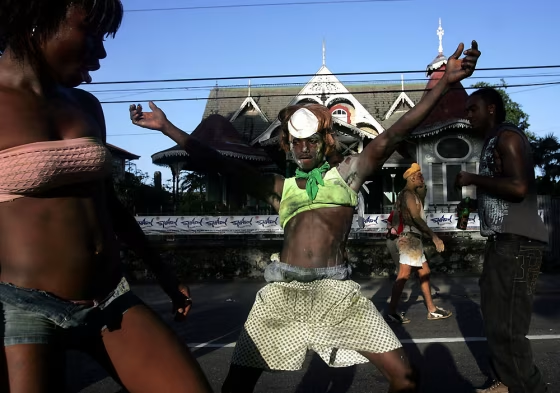
Disguised as fire-breathing dragons, glittery grim reapers and a huge translucent butterfly, masqueraders kicked off Carnival celebrations in Trinidad, while Calypso singers electrified crowds with songs of political corruption and recent natural disasters.
Dripping in sequins and sweat, dancers staggered across the stage to thumping drum beats Monday morning as the climax neared for the Caribbean's biggest and most lavish bash.
"This is what life should be like everyday!" shouted Orville Devi, 36, from Trinidad.
Leaders from 53 masquerade bands saddled with intricate and heavy costumes - some as wide as a large tree canopy and as high as 30 feet - gathered for Dimanche Gras, or Carnival Sunday, that dragged into Monday morning for the crowning of Carnival King & Queen.
Curtis Eustace was crowded king for his towering costume resembling an orange and black dragon, adorned by golden skulls on its expansive sparkling appendages. Pamela Gordon was crowed Carnival Queen for her giant translucent butterfly that was as big as a dump truck.
One masquerader wore a sparkling grim reaper-like figure attached to his body that towered over his head and shot out white firecrackers. Another costume was a lanky white vulture with bulging eyes, an expansive purple and red wing span and a troupe of fire-blowing devil dancers.
Other female costumes included a gargantuan orange and gold Indian princess and a Carmen Miranda-like costume laden with fruit and giant fake parrots lifting the masquerader's skirt.
Carnival, which culminates with a grand parade on Tuesday, was introduced to Trinidad by French immigrants in the 1700s. Before Ash Wednesday and Lent, sugar plantation owners doused themselves in molasses and dressed up as slaves. The slaves - celebrating the end of the sugar cane harvest - dressed up in pantaloons and robes to parody their masters.
One of its oldest staples has been the Calypso competition. Calypso, with its pulsating beats and political satire, is rooted in African traditions of improvised songs.
This year's artists included well-known Calypso stars such as Chalkdust, who was crowned this year's Calypso monarch for his song "Ah doh Rhyme." The song is about how anger over Trinidad's political corruption and exploited gas and oil reserves keeps him from rhyming.







 FOR SUBSCRIBERSA harrowing ordeal aboard an Israel-bound plane






FOR SUBSCRIBERSThe debate over AI’s future rages on both coasts

FOR SUBSCRIBERSA harrowing ordeal aboard an Israel-bound plane
FOR SUBSCRIBERSThe debate over AI’s future rages on both coasts
Another Calypso star, Brian London, sang about the tsunami that killed more than 160,000 people in Asia, and floods and hurricanes that lashed the Caribbean.
Covered by bandages and black marks, Calypso singer Lesley Ann Ellis stripped off her clothes during her show to reveal a Karate outfit as she sang, "Tonight," about domestic violence, an issue plaguing the Caribbean and Latin America.
"The poetry of Calypsonians is known across the world," said Winston Smith, 23, from Brooklyn, New York. "It doesn't matter if you're from the Caribbean or American. What matters is that these people are talking about things politicians don't have the guts to tackle."
Trinidad's fete is expected to draw more than 1 million people - almost doubling the Caribbean nation's population of 1.3 million - and generate $1 billion in business.
Just before daybreak on Monday, revelers will strip off their fancy costumes and smear themselves in mud or oil for J'Ouvert (opening day), which brings a re-enactment of the Canboulay Riots of 1881, when soldiers were beaten back with sticks and stoned by black masqueraders for attempting to stop them taking part in carnival.
Carnival culminates on Tuesday with a grand parade in Trinidad's Queen's Park Savannah, a sprawling park in the center of the capital, Port-of-Spain.