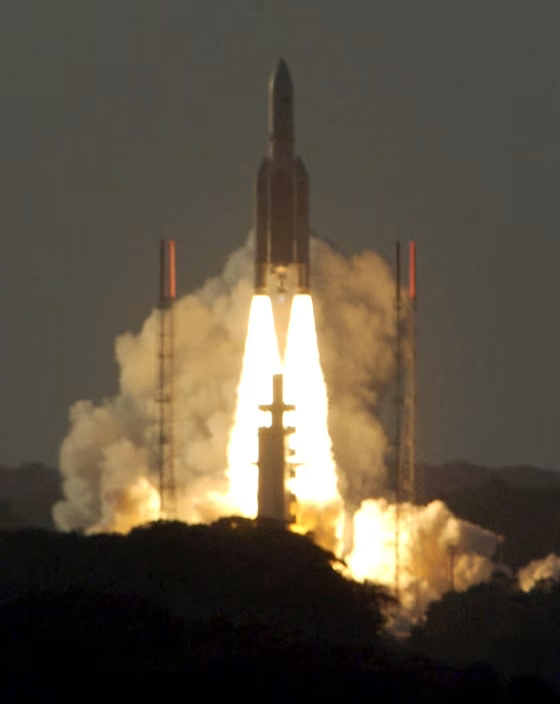
In a crucial mission for Europe’s space program, an upgraded Ariane 5 rocket successfully put two satellites into space Saturday, two years after a first attempt ended in failure.
Space officials said the Ariane 5 lifted off from Europe’s spaceport in Kourou, on the northeast coast of South America at 6.03 p.m. (4:03 p.m. ET).
Twenty-six minutes after launch, space officials said the XTAR-EUR satellite separated from the rocket. This was followed five minutes later by the separation of the second satellite Sloshsat.
A first attempt to launch an upgraded Ariane 5 in December 2002 failed when the rocket veered off course and was destroyed by ground control.
An inquiry board determined that a malfunction in the cooling system of the rocket’s Vulcain engine was to blame, which destroyed Ariane’s half-billion-dollar satellite payload.
The upgraded version of the Ariane 5 is capable of launching communication satellite payloads of up to 10 metric tons. The current “Generic” version of the Ariane 5, first launched in 1996, has a maximum capacity to launch payload of up to 6.8 metric tons.
The added capacity is essential to lower launch costs in an industry that has experienced a downturn, largely due to increased competition and shrinking demand for communications satellites.







 FOR SUBSCRIBERSA harrowing ordeal aboard an Israel-bound plane






FOR SUBSCRIBERSThe debate over AI’s future rages on both coasts

Jean-Yves Le Gall, president of the Arianespace company that builds and launches the Ariane rocket series, said before the launch: “Ariane 5 will be the workhorse of our company, and the European space industry as well for the next 10 years.”
FOR SUBSCRIBERSA harrowing ordeal aboard an Israel-bound plane
FOR SUBSCRIBERSThe debate over AI’s future rages on both coasts
“So this launch is very important,” he said.
Le Gall said he hoped the upgraded Ariane 5 rocket would lower launch costs from $30,000 to $40,000 per kilogram with the current Generic Ariane 5 to $15,000 to $20,000 per kilogram ($6,000 to $9,000 per pound).
Independent access to space has been the driving force behind Europe’s space program, which is funded largely by France.