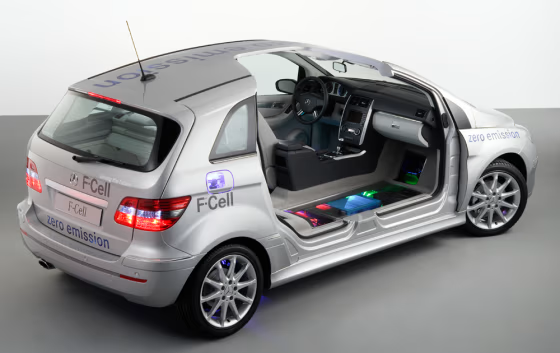
DaimlerChrysler on Wednesday unveiled a sporty fuel cell concept car, one that increases the range and power of earlier versions. Based on Mercedes' new B-Class, the car made its debut at the 2005 Geneva Motor Show in Geneva, Switzerland.
"With this car, we are continuing our highly successful practical tests on an even larger scale," Thomas Weber, a DaimlerChrysler research and technology executive, said in a statement accompanying the announcement.
The electric motor powered by the fuel cell puts out more than 100 kilowatts, DaimlerChrysler said, 35 kW more than its predecessor.
















The range has increased to nearly 250 miles, the company added, due to reduced fuel consumption and greater hydrogen storage capacity. Earlier versions had a range of around 150 miles.
The announcement follows a similar one by General Motors at the Detroit auto show in January, when the Sequel fuel cell car was unveiled with specs that include a 300-mile range and improved acceleration.
Most automakers are working with fuel cells, but only GM has stated it aims to bring them to market by 2010.
Obstacles include the high costs of the fuel cell stack, the lack of a refueling infrastructure, and the fact that hydrogen must be extracted either from a fossil fuel or renewable power, both costly processes. Hydrogen is used with air to create a chemical reaction in the fuel cells that produces electricity to power a vehicle.
Advantages to fuel cells include a system that's twice as efficient as an internal combustion engine and zero-emissions from the tailpipe.
"In the long term, the fuel cell provides the best opportunities for securing uncompromisingly environment-friendly mobility for the automobile," DaimlerChrysler stated, adding that it is testing more than 100 fuel cell cars, vans and buses on roads around the world.