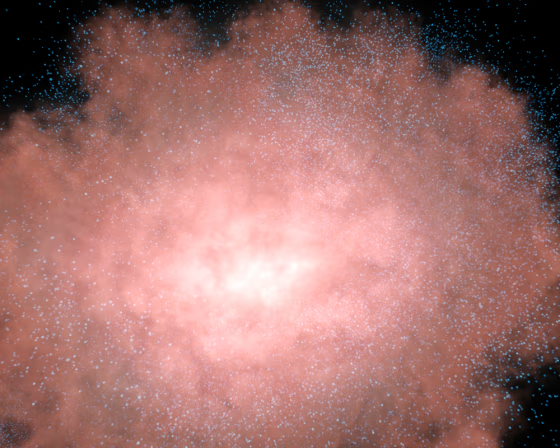
NASA scientists said an infrared telescope peered deep into stardust and spotted hidden galaxies more than 11 billion light-years from Earth.
In a journal article this week, the scientists describe how the Spitzer Space Telescope was used to find the galaxies, the most luminous in the universe. The galaxies shine with light equivalent to 10 trillion suns but are too far away and too drenched in cosmic dust to be seen -- until now.
"We are seeing galaxies that are essentially invisible," said Dan Weedman of Cornell University, in Ithaca, N.Y., who co-authored an article on the discovery in Astrophysical Journal Letters.
















By studying these galaxies, we'll get a better idea of our own galaxy's history," said lead author James Houck, also of Cornell.
The Spitzer infrared telescope, a $670 million mission launched in August 2003, is managed by NASA's Jet Propulsion Laboratory in Pasadena.
"Past infrared missions hinted at the presence of similarly dusty galaxies over 20 years ago, but those galaxies were closer. We had to wait for Spitzer to peer far enough into the distant universe to find these," said Weedman.