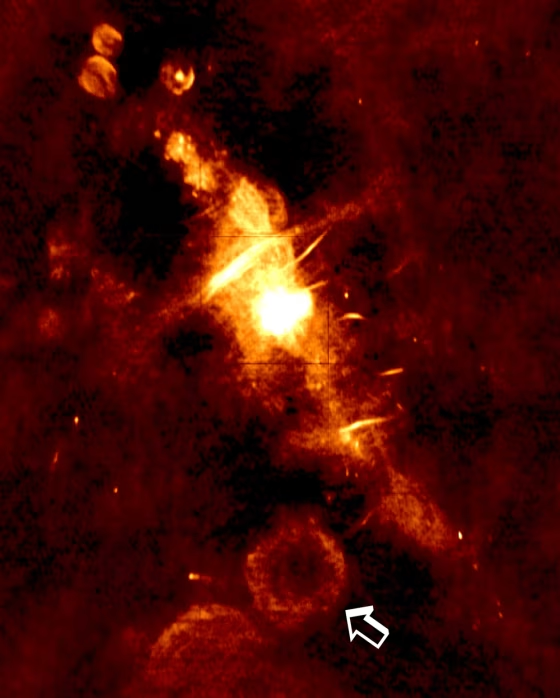
A strange and powerful burst of radio waves from near the center of our galaxy may have come from a previously unknown type of space object, astronomers reported Wednesday.
Other experts nicknamed the mysterious source a "burper" and said there would be a race to scan for similar radio bursts.
"We hit the jackpot," said Scott Hyman, a professor of physics at Sweet Briar College in Virginia, who led the study. "An image of the galactic center, made by collecting radio waves of about 1 meter (3 feet) in wavelength, revealed multiple bursts from the source during a seven-hour period from Sept. 30 to Oct. 1, 2002 — five bursts in fact, and repeating at remarkably constant intervals."
The burst came from the direction of the middle of the Milky Way galaxy, of which Earth is a part, and could have originated from as far away as 24,000 light-years or from as close as 300 light-years. A light-year is the distance light travels in a year, or about 6 trillion miles (10 trillion kilometers).
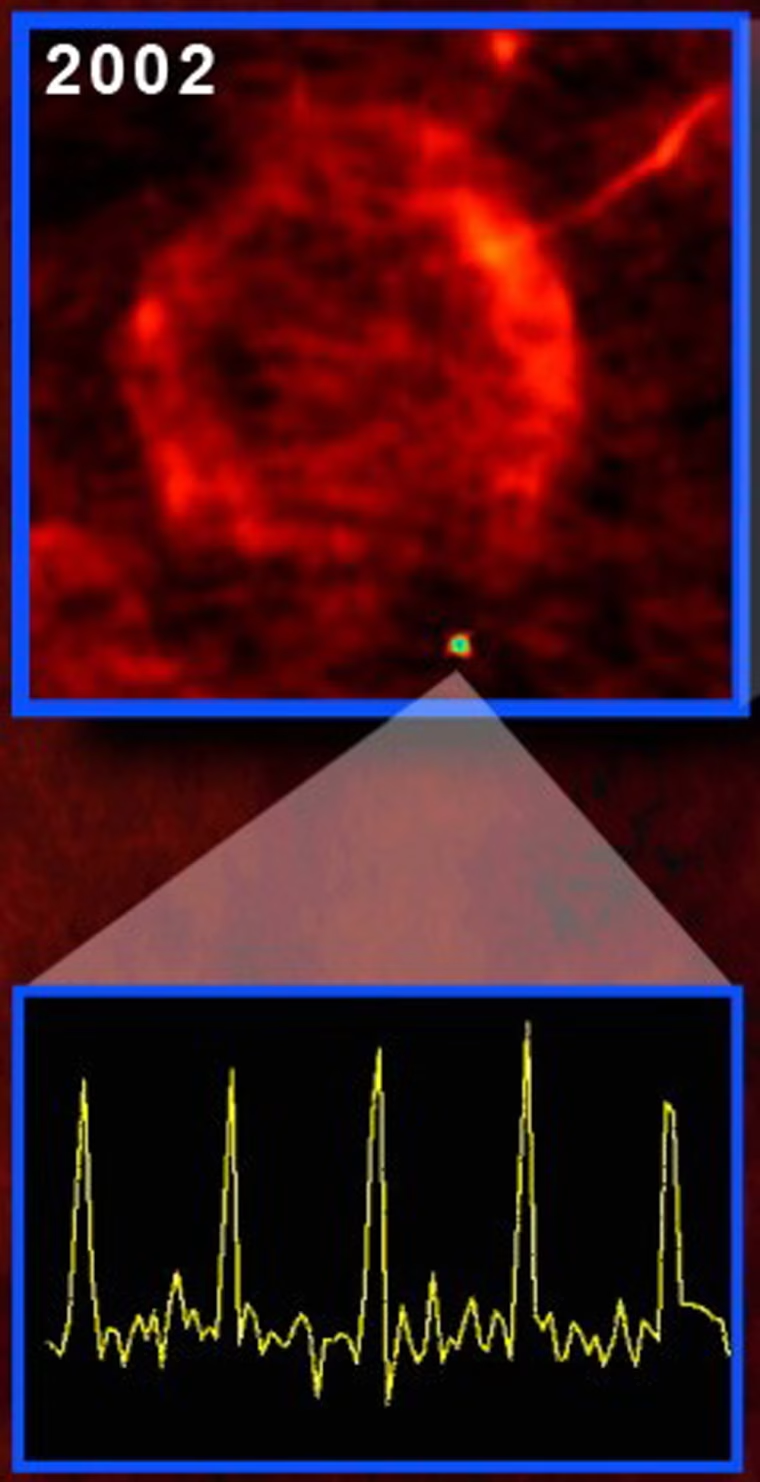
It cannot have come from a celestial object known as a pulsar, the researchers write in Thursday's issue of the journal Nature, but the source could be a brown dwarf of a magnetar — an exotic star with an extremely powerful magnetic field.
They have named the presumed object GCRT J1745-3009.







 FOR SUBSCRIBERSA harrowing ordeal aboard an Israel-bound plane







FOR SUBSCRIBERSThe debate over AI’s future rages on both coasts

FOR SUBSCRIBERSA harrowing ordeal aboard an Israel-bound plane
FOR SUBSCRIBERSThe debate over AI’s future rages on both coasts
"GCRT J1745-3009 will cause a stampede of further observations," Shri Kulkarni and Sterl Phinney of the California Institute of Technology wrote in a commentary. "But perhaps even more important is the possibility that the radio heavens contain other fast radio transients (which, in anticipation of a trove of discoveries, we nickname 'burpers')."
Hyman and colleagues made the discovery by studying observations made by the National Science Foundation's Very Large Array radio telescope in New Mexico.