Art and fatherhood became intertwined when John R. Phelps volunteered to paint a portrait that would be included in a tribute to soldiers killed in Afghanistan and Iraq. His subject was his son.
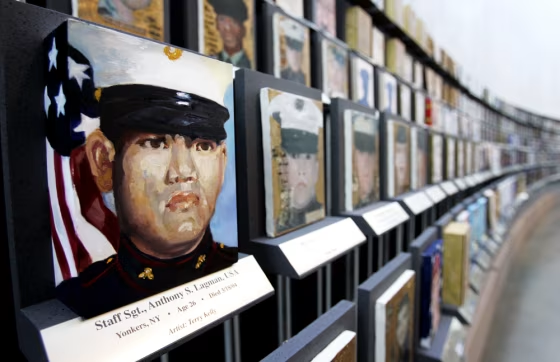
Phelps’ painting of Marine Pfc. Clarence Phelps is among 1,327 images of soldiers in an exhibit titled “Faces of the Fallen.” It opens to the public Wednesday at Arlington National Cemetery.
“It’s a stunning array of pictures,” Phelps said after his first view of it. “They were all brave Americans.”
Phelps, a professional artist in Dubois, Wyo., served four years in the Navy during the Vietnam War, loading ordnance aboard an aircraft carrier. He remains an unabashed supporter of the Iraq war despite the death of his son, who suffered fatal head wounds April 9 while helping defend a convoy in Ramadi, west of Baghdad.
“We’re fighting them on their own ground,” he said. “If we don’t, they’d be over here.”
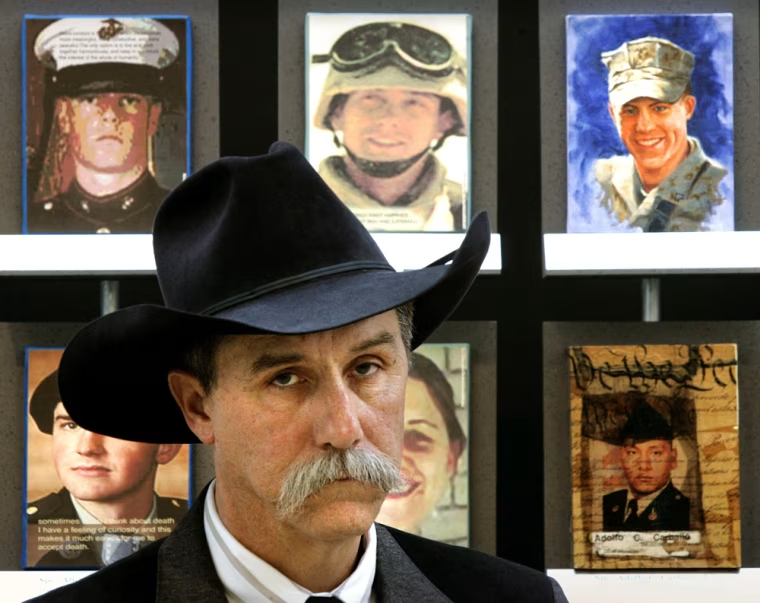
The images of the soldiers, each 6-by-8 inches, are mounted on plain steel rods that reach to near eye level. Each rod includes a label with the soldier’s name, hometown and date of death.
Five rows are arranged chronologically by the soldiers’ times of death and stretch along a half-circle inside the small museum at the entrance to the cemetery. The number of images does not represent all those killed — that figure now is more than 1,600.
Towina Nightingale of Highland, Ind., visited the display Tuesday to see the portrait of her son, Army Ranger Nathan E. Stahl. He was killed by a roadside bomb in Iraq on Sept. 21 after jumping from a helicopter to help on a rescue mission, she said.







 FOR SUBSCRIBERSA harrowing ordeal aboard an Israel-bound plane





FOR SUBSCRIBERSThe debate over AI’s future rages on both coasts
FOR SUBSCRIBERSA harrowing ordeal aboard an Israel-bound plane
FOR SUBSCRIBERSThe debate over AI’s future rages on both coasts
Nightingale said she greatly admired the painting of her son by Hardy Granville Garner and hoped to meet him. The artists, who received no money for their work, have promised to give the portraits to relatives after the exhibit closes.
“I’d love to take this one home right now,” she said.
Behind every death, a human being
Annette Polan, head of the Corcoran College of Art and Design’s painting department, said she was moved to create the memorial after seeing all the photos of dead soldiers displayed in a newspaper.
Polan, 60, said she wanted to show that every death is an individual, each with special hopes and dreams and memories. She hopes it can have the same healing effect as the Vietnam Veterans Memorial on the National Mall.
“We wanted to make the exhibit as apolitical as possible,” she said.
A portraitist herself who has painted Supreme Court Justice Sandra Day O’Connor, Polan did nine of the collection’s portraits. She assigned the others to artists she knew, either personally or through their work.
The artists worked mostly from newspaper and Internet photos, and some sent by families of the dead. A large portion of the portraits were done conventionally, in color on canvas, but in other cases artists experimented with the images.
Artists’ vision ‘from their hearts’
“As you view the image of your loved one, please bear in mind that each artist’s hand and way of seeing is different from another’s, just as each of our fingerprints are unique,” Polan said in a Web site note to families. “All the artists have worked respectfully and from their hearts.”
Jason Zimmerman, a Washington artist, said he took a photo, inserted it in a computer imaging program. manipulated it “to make a ghostly kind of image” and printed it on a heavy cotton fabric by ink-jet process.
Another artist molded low-relief images in clay. Another did scratch board drawings. Another did not portray faces at all, just flowers. The dead for whom no portraits could be made, for lack of photos or other reasons, are represented by generic black-and-white silhouettes.
The exhibit will be on display through Labor Day, Sept. 5.