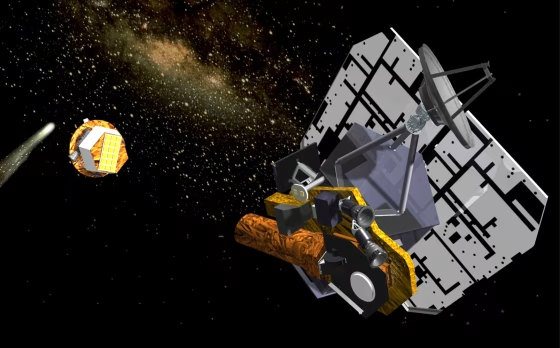
NASA’s Deep Impact spacecraft is on course for a July 4 encounter with Comet Tempel 1, but mission officials are trying to determine why one of the probe’s telescopes has not focused properly, the space agency said Friday.
The problem was discovered after a process called a “bake-out” in which heat is used to remove residual moisture from the telescope, which absorbed moisture as the spacecraft waited on the launch pad and flew through the atmosphere into space.
Testing showed the telescope has not focused perfectly, and scientists are searching for ways to fix it.

 FOR SUBSCRIBERSCBP leaders cut out of Trump ad buy decision









FOR SUBSCRIBERSA harrowing ordeal aboard an Israel-bound plane





“This in no way will affect our ability to impact the comet on July 4,” Rick Grammier, Deep Impact project manager at NASA’s Jet Propulsion Laboratory, said in a statement.
FOR SUBSCRIBERSCBP leaders cut out of Trump ad buy decision
FOR SUBSCRIBERSA harrowing ordeal aboard an Israel-bound plane
Deep Impact, launched Jan. 12, carries an “impactor” that will be released to collide with the comet, possibly creating a stadium-size gouge while the spacecraft’s instruments collect data on the material that is hurled off.
The impact will also be observed by NASA’s space telescopes and telescopes on Earth.