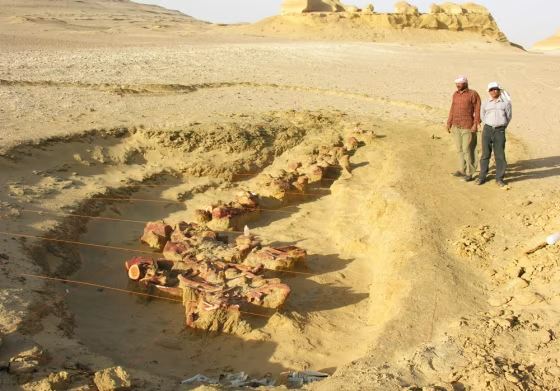
An American paleontologist and a team of Egyptians have reported finding the nearly complete fossilized skeleton of a primitive whale in Egypt's Western Desert.
Philip Gingerich of the University of Michigan excavated the well-preserved skeleton, which is about 40 million years old, in a desert valley known as Wadi Hitan (the Valley of the Whales) southwest of Cairo, university spokesman Karl Bates told Reuters on Monday.
"His feeling is that it's the most complete — the whole skeleton from stem to stern," said Bates.
The skeleton of a Basilosaurus isis, which is 50 feet (18 meters) long, could throw light on why there are so many fossilized remains of whales and other ancient sea animals in Wadi Hitan and possibly how the extinct animal swam, he said.
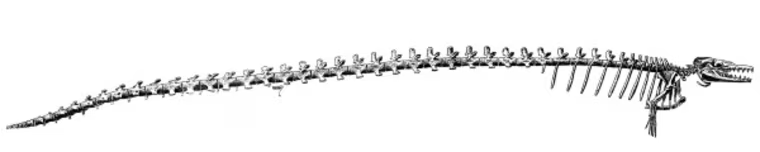
Basilosaurus isis is one of the primitive whales known as archaeocetes, which evolved from land mammals and later evolved into the two types of modern whale. But it looks like a giant sea snake, and the paleontologists who found the first archaeocetes thought they were reptiles.
Modern whales swim by moving their horizontal fluke up and down in the water, while fish swim by lateral undulations.







 FOR SUBSCRIBERSA harrowing ordeal aboard an Israel-bound plane







FOR SUBSCRIBERSThe debate over AI’s future rages on both coasts

FOR SUBSCRIBERSA harrowing ordeal aboard an Israel-bound plane
FOR SUBSCRIBERSThe debate over AI’s future rages on both coasts
"The research team will use the new skeleton to study how it lived and swam, and possibly to learn why it so abundant in Wadi Hitan," Gingerich said in a statement.
The statement said the skeleton will go to Michigan for preservation and replication. The original will then come back to Egypt for display.
Wadi Hitan is unusually rich in fossil remains from the period, trapped in a sandstone formation that then formed the sea bed. The fossils include five species of whale, three species of sea cow, two crocodiles, several turtles, a sea snake and large numbers of fossilised sharks and bony fish.
It is a protected area to be developed as a national park under an Italian-Egyptian cooperative program, and it has been nominated as a UNESCO World Heritage site because of its natural beauty and scientific importance.