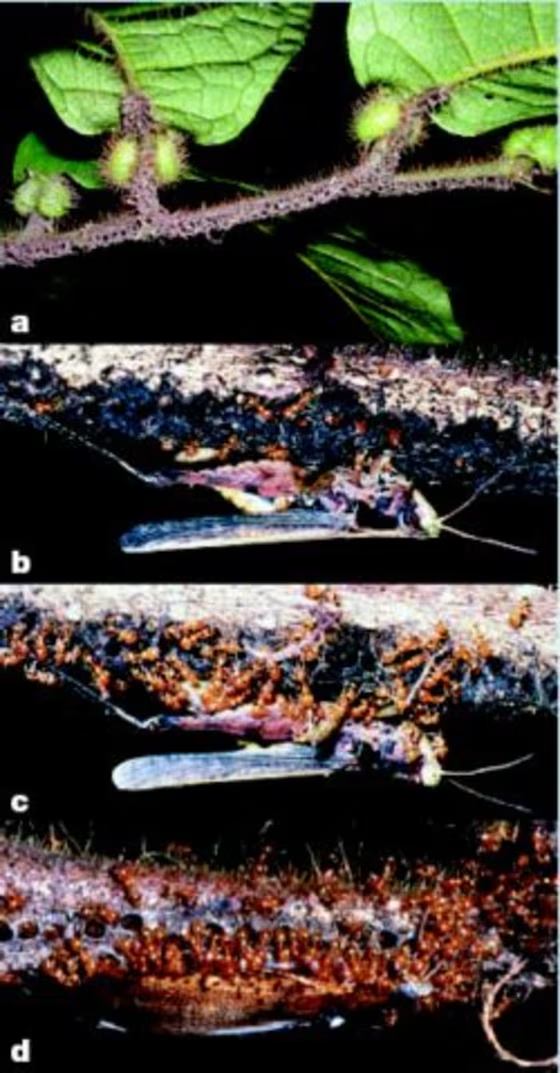
A crafty ant species builds a trap dotted with foxholes for surprise attacks on an insect. They stretch their victim out like a medieval criminal on a rack as more ants swarm in for the kill.
Such incredible cooperation among ants has never before been described by scientists.
The ants, called Allomerus decemarticulatus, live in trees in the Amazon. Their trap is made of natural plant hairs, some regurgitated goo, and a binding fungus that the ants, amazingly, appear to farm. It allows the ants to snag a meal, such as a large flying insect, that they otherwise could not handle.
Here's how it works:
An insect lands on the trap, which to the unsuspecting eye looks like part of the tree. Ants spring from dozens of holes in the gallery-like structure and grab the bug's legs, stretching them out to immobilize the large prey. Other worker ants swiftly arrive to sting the bug to death. Before long, the insect is carved up and carted away.
The ambush is well orchestrated, as University of Toulouse researcher Jerome Orivel and his colleagues describe in the April 21 issue of the journal Nature.
"Allomerus workers hide in the galleries with their heads just under the holes, mandibles wide open, seemingly waiting for an insect to land," the scientists write. "To kill the insect, they grasp its free legs, antennae or wings, and move in and out of holes in opposite directions until the prey is progressively stretched against the gallery and swarms of workers can sting it."







 FOR SUBSCRIBERSA harrowing ordeal aboard an Israel-bound plane







FOR SUBSCRIBERSThe debate over AI’s future rages on both coasts



The ants then slide the prey across the gallery, again moving in and out of holes, but this time in the same direction. "They move it slowly towards a leaf pouch, where they carve it up."
FOR SUBSCRIBERSA harrowing ordeal aboard an Israel-bound plane
FOR SUBSCRIBERSThe debate over AI’s future rages on both coasts
The key to building the trap is a fungus that the ants cultivate. The fungus grows on the trap and solidifies the structure. The researchers grew some tree saplings as a test. If the ants were not present, no fungus grew, but if the ants were there, the saplings developed the fungus.
Orivel marvelled over the trap-building.
"It is something manufactured by the ants from elements coming from the plant and the environment," he said in an email interview. "Contrary to social spiders which are also collectively building a trap (their web) from the silk they produce, the trap of Allomerus is made from external products."
"To our knowledge, the collective creation of a trap as a predatory strategy has not been described before in ants," the researchers conclude.