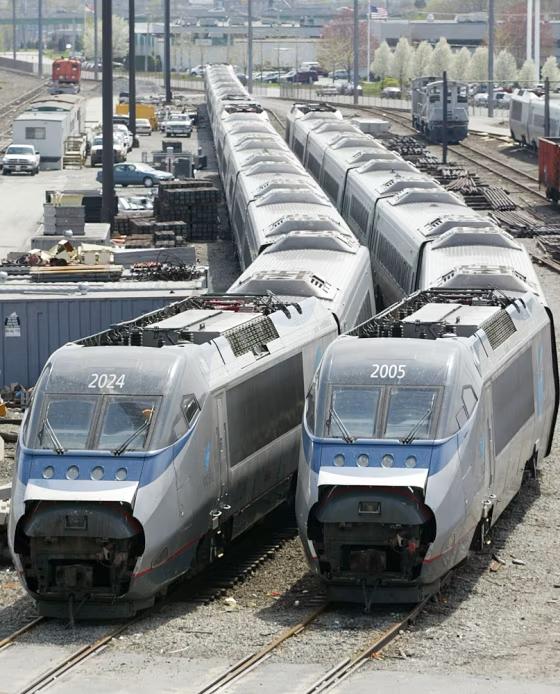
Amtrak President David Gunn said Wednesday he believes the makers of the Acela Express trains overestimated the life expectancy of their brake rotors, forcing Amtrak to pull the entire fleet out of service for repairs.
"I believe they misjudged the life of the rotors," Gunn told The Associated Press during a break in a House Appropriations subcommittee hearing on Amtrak's Fiscal 2006 budget. "Their life expectancy was less than they had planned and they were caught without a supply."
Helene Gagnon, a spokeswoman for Montreal-based Bombardier Inc., said the brakes' disc face — or front of the disc — showed normal wear. What caused the cracks on the spokes of the brakes was still under investigation, which will take weeks to determine, Gagnon said. When the train brakes are applied, the brake pads rub against the disc face, causing friction, she added.
Bombardier and Alstom SA of France make the Acela trains, and have said the brakes were to last 1 million miles. The current Acela fleet had about half of that mileage, Gunn said.
Gunn said the timetable for bringing back the Acela trains on a gradual basis was still this summer, adding that Bombardier and Alstom had yet to give Amtrak a delivery schedule for the brakes. Gagnon said the companies hoped to have a schedule within a few days.
Amtrak was forced to pull all of its 20 Acela trains out of service on April 15 after finding millimeter-size cracks in 300 of the high-speed rail fleet's 1,440 disc brake rotors. Each Acela train has 72 brakes.







 FOR SUBSCRIBERSA harrowing ordeal aboard an Israel-bound plane







FOR SUBSCRIBERSThe debate over AI’s future rages on both coasts

The brake problem surfaced when a Federal Railroad Administration worker performed a routine inspection April 14 after a high-speed run to test whether Amtrak could speed up the Acela trains slightly on curves in New Jersey between Trenton and Newark.
FOR SUBSCRIBERSA harrowing ordeal aboard an Israel-bound plane
FOR SUBSCRIBERSThe debate over AI’s future rages on both coasts
Amtrak's chief operating officer Bill Crosbie said last week that the brake part is unique to the Acela and there was no active production line casting them. Crosbie said the companies had fewer than 70 disc brakes in stock.
Amtrak has had to replace its Acela train routes with slower trains to operate its Washington to Boston trips.
Acela Express began operating in December 2000 and was billed as Amtrak's answer to high-speed rail. The trains run only along the Northeast corridor, with top speeds of 150 mph. Acela trains can get from Washington to New York City in two hours and 48 minutes, while its regular fleet takes more than three hours.