The world’s first solar sail spacecraft crashed back to Earth when its booster rocket failed less than two minutes after Tuesday’s takeoff, Russian space officials said Wednesday.
The Cosmos 1 vehicle, a joint U.S.-Russian project, was intended to show that a solar sail can make a controlled flight. Solar sails, designed to be propelled by pressure from sunlight, are seen as a potential means for achieving interstellar flight, allowing such spacecraft to gradually build up great velocity and cover large distances.
But the Volna booster rocket failed 83 seconds after its launch from a Russian nuclear submarine in the northern Barents Sea just before midnight Tuesday in Moscow, the Russian space agency said.
Its spokesman, Vyacheslav Davidenko, said that “the booster’s failure means that the solar sail vehicle was lost.” The Russian navy began a search for debris from the booster and the vehicle, he said.
Scientists had held out hope
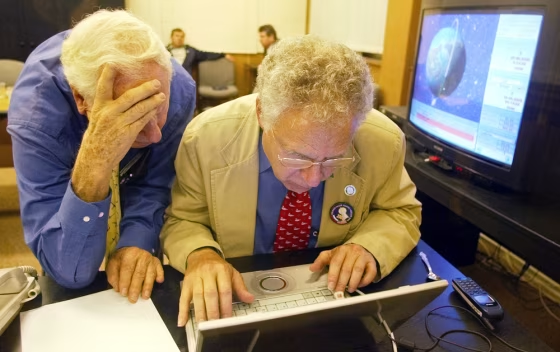
U.S. scientists had said earlier that they possibly had detected signals from Cosmos 1 but cautioned that it could take hours or days to figure out exactly where the $4 million spacecraft was.
The signals were picked up late Tuesday after an all-day search for the spacecraft, which had suddenly stopped communicating after its launch, they said.
“It’s good news because we are in orbit — very likely in orbit,” Bruce Murray, a co-founder of The Planetary Society, which organized the mission, said before the Russian space agency’s announcement.
A Russian government panel will investigate possible reasons behind the failure of the three-stage rocket’s first-stage engine, Davidenko said.
Past attempts to unfold similar devices in space have failed.
In 1999, Russia launched a similar experiment with a sun-reflecting device from its Mir space station, but the deployment mechanism jammed and the device burned up in the atmosphere.
In 2001, Russia again attempted a similar experiment, but the device failed to separate from the booster and burned in the atmosphere.
The project was organized by the Planetary Society, a California-based organization that counts the late astronomer Carl Sagan as one of its founders. Funding came largely from Cosmos Studios, a science-based entertainment company that was founded by Sagan’s widow, Ann Druyan. Russia’s Lavochkin research production institute built the vehicle.
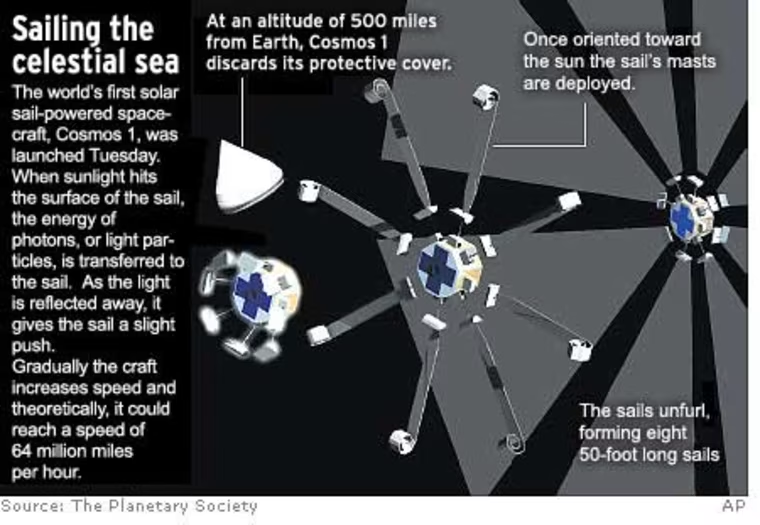
The solar sail vehicle weighed about 242 pounds (110 kilograms) and was designed to go into an orbit more than 500 miles (800 kilometers) high. It was designed to be powered by eight 49½-foot-long (15-meter-long) sail structures resembling the blades of a windmill.
Each blade can be turned to reflect sunlight in different directions so that the craft can “tack,” much like a sailboat in the wind.







 FOR SUBSCRIBERSA harrowing ordeal aboard an Israel-bound plane







FOR SUBSCRIBERSThe debate over AI’s future rages on both coasts

FOR SUBSCRIBERSA harrowing ordeal aboard an Israel-bound plane
FOR SUBSCRIBERSThe debate over AI’s future rages on both coasts
Controlled flight would have been attempted early next week, and Cosmos 1 was supposed to operate for at least a month.