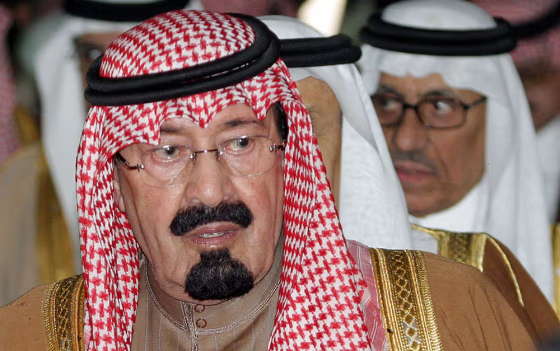
The new ruler of Saudi Arabia, King Abdullah bin Abdul-Aziz, has championed modest reform of his country’s absolute monarchy as it struggles with a wave of al-Qaida violence and a crisis in relations with its key ally, the United States.
The quietly-spoken Abdullah, who was born in 1924, was pronounced king after his elder brother Fahd died on Monday.
Diplomats said they did not expect major changes in Saudi foreign or oil policy under Abdullah, who as crown prince took day-to-day charge of the oil giant after Fahd had a stroke in 1995.
Low oil prices and big state deficits were Abdullah’s early challenges but the Sept. 11, 2001, attacks in the United States -- carried out mainly by Saudi-born hijackers -- and later al-Qaida bombings in the Persian Gulf state itself posed an even greater threat.
Despite a reputation for being more Arab nationalist than his pro-American brother, Abdullah worked to restore ties with Washington clouded by the Sept. 11 attacks and charges that Saudi Arabia’s Wahabi Islam fostered anti-Western violence.
When al-Qaida suicide bombers began a wave of attacks in 2003 aimed at toppling the House of Saud and severing links with an “infidel” West he launched an unprecedented crackdown, warning the battle could last for decades.
“Terrorism will not go away overnight and our war against terrorism will be long and bitter,” he said in February 2005.
Hand-in-hand with the security measures Abdullah instigated tentative political reforms including a dialogue on national challenges, partial elections to municipal councils and a gradual expansion of the consultative Shura assembly.
Critics dismissed the steps as superficial and said the jailing of petitioners calling for a constitutional monarchy showed the true royal priorities.
But Abdullah said that changing the conservative and traditional kingdom, which is also the cradle of Islam, could take as long as the battle against terrorism.
“The state is proceeding, with the help of God, in its gradual and studied course of reform,” he said, vowing to ignore both conservatives calling for “stagnation and immobility” and liberals seeking a “leap into darkness and reckless adventure”.
Austere tastes
In a family famed for lavish excess, Abdullah’s fondness for retreats at his desert camp marked him out from other princes who preferred to spend summers in Mediterranean palaces.
Abdullah has also earned a reputation for honesty and commands wide respect in the region.

 FOR SUBSCRIBERSCBP leaders cut out of Trump ad buy decision









FOR SUBSCRIBERSA harrowing ordeal aboard an Israel-bound plane





He is among some 30 surviving sons of the late King Abdul-Aziz, who founded the modern state of Saudi Arabia in 1932. As head of the U.S.-trained National Guard since 1962 he enjoys tribal backing.
FOR SUBSCRIBERSCBP leaders cut out of Trump ad buy decision
FOR SUBSCRIBERSA harrowing ordeal aboard an Israel-bound plane
But with only half-brothers within the royal family, diplomats say the octogenarian Abdullah’s power has its limits. Fahd has six full brothers who collectively wield great influence and can band together at family meetings.
In the wider Middle East, Abdullah, an advocate of Arab rights, floated a land-for-peace proposal to resolve the Arab-Israeli conflict, an Arab charter urging more political participation, and a failed drive to avoid war in Iraq.
While Saudi Arabia was a main launchpad for the 1991 Gulf War that freed Kuwait from Iraqi occupation, it publicly opposed the U.S.-led invasion of Iraq 12 years later.
After the 2003 war, the United States removed virtually all its forces from Saudi Arabia, ending a major military presence which dated back to 1990 and had helped Saudi-born al-Qaida leader Osama bin Laden rally militants against the royal family.
But within weeks of the U.S. withdrawal, bin Laden’s supporters launched their campaign against Saudi Arabia with triple suicide bombings, killing 35 people in Riyadh.
Abdullah’s Middle East proposal -- which offers Israel normal Arab ties in exchange for full Israeli withdrawal from all Arab land occupied in the 1967 Arab-Israeli War -- led bin Laden to label him as a traitor to Arabs and Islam.
But Abdullah also publicly criticized U.S. support for Israel, while emphasizing the importance of U.S.-Saudi relations that have lasted since the kingdom was founded.
For years Abdullah warned the fast-growing Saudi population about economic realities their kingdom could not escape, particularly in the oil price slump of the late 1990s.
He bluntly told his country the boom times were over and ordered an end to extravagant government spending. Conscious of the social costs of unemployment, Abdullah also urged the private sector to take control of the economy from the state.
He has tried to reform the oil-reliant economy, promoting a liberalized investment law, an overhaul of the capital markets and opening the gas sector to Western firms, although a two-year surge in oil prices may have taken the urgency out of reforms.