Finally, a virus infects a worm and it has nothing to do with computers. But it does have a lot to do with humans.
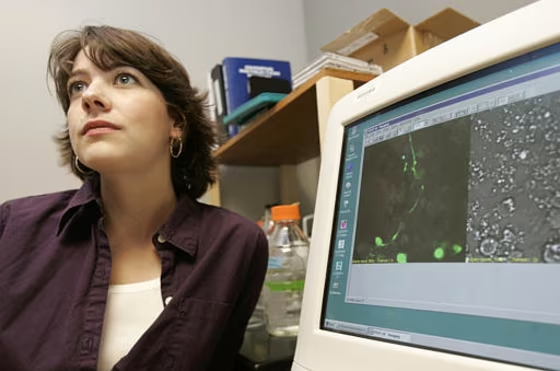
Courtney Wilkins, a microbiology and immunology student at the University of Arkansas for Medical Sciences, successfully infected the Caenorhabditis elegans earthworm with the mammalian vesicular stomatitis virus and had it replicate.
Others had tried and failed before, and Wilkins' breakthrough will let researchers learn more about how viruses move from one host to another, and what proteins they attach to in humans. Some cells in the C. elegans, a microscopic earthworm commonly used in biomedical research, are similar to some human cells.
"There were a lot of labs interested in whether this could work, so it just seemed pretty exciting," she said Wednesday.
The research will also be featured in this month's edition of Nature magazine.
Since January 2002, Wilkins began studying whether she could infect the worms with a virus and have the virus spread. She usually worked with muscle or intestinal cells and eventually settled on using the vesicular stomatitis virus. The virus is related to rabies and similar to foot-and-mouth disease and mostly infects livestock, Wilkins said.
It took three to four months to establish the cell cultures.
Khaled Machaca, one of Wilkins' advisers and a professor of cell biology, said the experiment wasn't without its rough spots. He said that there were points when he had to remind Wilkins' that her decision to undertake the research was a risky one, because it was unknown whether it would work.
And that meant Wilkins' degree was at stake, because her career could be stopped if nothing came of the research, he said. After two years, it was clear that Wilkins was successful in her experiment.







 FOR SUBSCRIBERSA harrowing ordeal aboard an Israel-bound plane







FOR SUBSCRIBERSThe debate over AI’s future rages on both coasts

FOR SUBSCRIBERSA harrowing ordeal aboard an Israel-bound plane
FOR SUBSCRIBERSThe debate over AI’s future rages on both coasts
Wilkins remembered discovering about 9 p.m. one night in 2004 that the VSV had replicated inside the worm cell. She immediately called Marie Chow, a professor of virology and another adviser.
"Courtney gets so excited that she starts to stutter," Chow said. "She couldn't get the words out, so we knew there was something to it," she said.
Having successfully infected a C. elegans and had the VSV replicate in the worm's cells has many implications, Chow said.
She said that, with the research, there is now the opportunity to understand how viruses move from one host to another, and what proteins they attach to in humans, she said. Chow said it will also help scientists understand how this virus deals with different kinds of immune systems in insects and mammals.
Since her discovery, Wilkins' has taken her research to the American Society of Virology conference at Penn State University in State College, Pa., and also to the International Worm Meeting at UCLA.
The research will also be featured in this month's edition of Nature magazine.